
In 2026, the kitchen is no longer just a place for cooking—it is the hub of home wellness and smart living. As awareness of water quality grows, relies on bulky countertop pitchers or cluttering plastic bottles are quickly becoming a thing of the past. Kitchen filtered water faucets have skyrocketed in popularity because they seamlessly blend health, environmental responsibility, and sleek design directly into your culinary workspace.
Access to clean, great-tasting water at the turn of a handle is essential for everything from filling a morning water bottle to washing fresh produce. However, with dozens of brands claiming to have the "best" system, finding the right fit for your countertop layout and filtration needs can be overwhelming. This guide is designed to cut through the marketing noise, breaking down the technology and reviewing the top picks of 2026—including space-saving 3-way designs—to help you confidently choose the perfect filtered faucet for your home.
What Are Filtered Water Faucets?
A filtered water faucet is a faucet connected to a water filtration system. In most kitchens, it is installed on the sink or countertop and connected to an under-sink filter, reverse osmosis system, or multi-stage filtration unit.
Traditionally, a filtered water faucet is separate from the main kitchen faucet. It usually requires its own mounting hole on the sink or countertop. When you turn it on, it dispenses only filtered water.
A filtered water faucet is commonly used for:
- Drinking water
- Cooking water
- Coffee and tea
- Ice makers
- Baby formula
- Pet drinking water
The key difference is that a normal kitchen faucet delivers regular hot and cold tap water, while a filtered water faucet delivers water that has passed through a filter system.
When choosing one, look for safe, drinking-water-compatible materials. NSF notes that faucets and plumbing products intended for drinking water contact should meet standards such as NSF/ANSI/CAN 61 for material safety.
Why Do You Need Filtered Water Faucets?
A filtered water faucet is useful because it makes clean water easier to use every day. If filtered water is inconvenient, people tend to reach for bottled water or skip filtration altogether.
Main benefits include:
- Convenience: Filtered water is available instantly at the sink.
- Better taste: Many filters reduce chlorine taste, odor, and sediment.
- Less plastic waste: A good faucet-and-filter setup can reduce bottled water use.
- Cleaner countertop: Under-sink systems keep the filter hidden.
- Better cooking results: Filtered water can improve the taste of coffee, tea, soup, rice, and pasta.
- Long-term value: Replacement cartridges usually cost less than buying bottled water over time.
For families who drink a lot of water, a kitchen filtered water faucet is often one of the most practical upgrades in the kitchen.
Do Kitchen Faucet Water Filters Work?
Yes, kitchen faucet water filters can work well, but performance depends on the filter type, certification, and contaminant claims.
A filter should be chosen based on your water problem. For example:
- Carbon filters can improve taste and reduce chlorine.
- NSF/ANSI 53-certified filters may reduce certain health-related contaminants such as lead.
- Reverse osmosis systems can reduce dissolved solids, heavy metals, and other contaminants.
- NSF/ANSI 58 is commonly associated with reverse osmosis systems.
- EPA guidance recommends checking labels for NSF/ANSI 53 or NSF/ANSI 58 certification when looking for PFAS reduction claims.
The important point is this: do not judge a filter only by marketing language. Check the exact model number, certification, and contaminant reduction list.
A faucet alone does not filter water. The filter system connected to it does the real work.
What Is a 3 Way Kitchen Faucet with Filter?
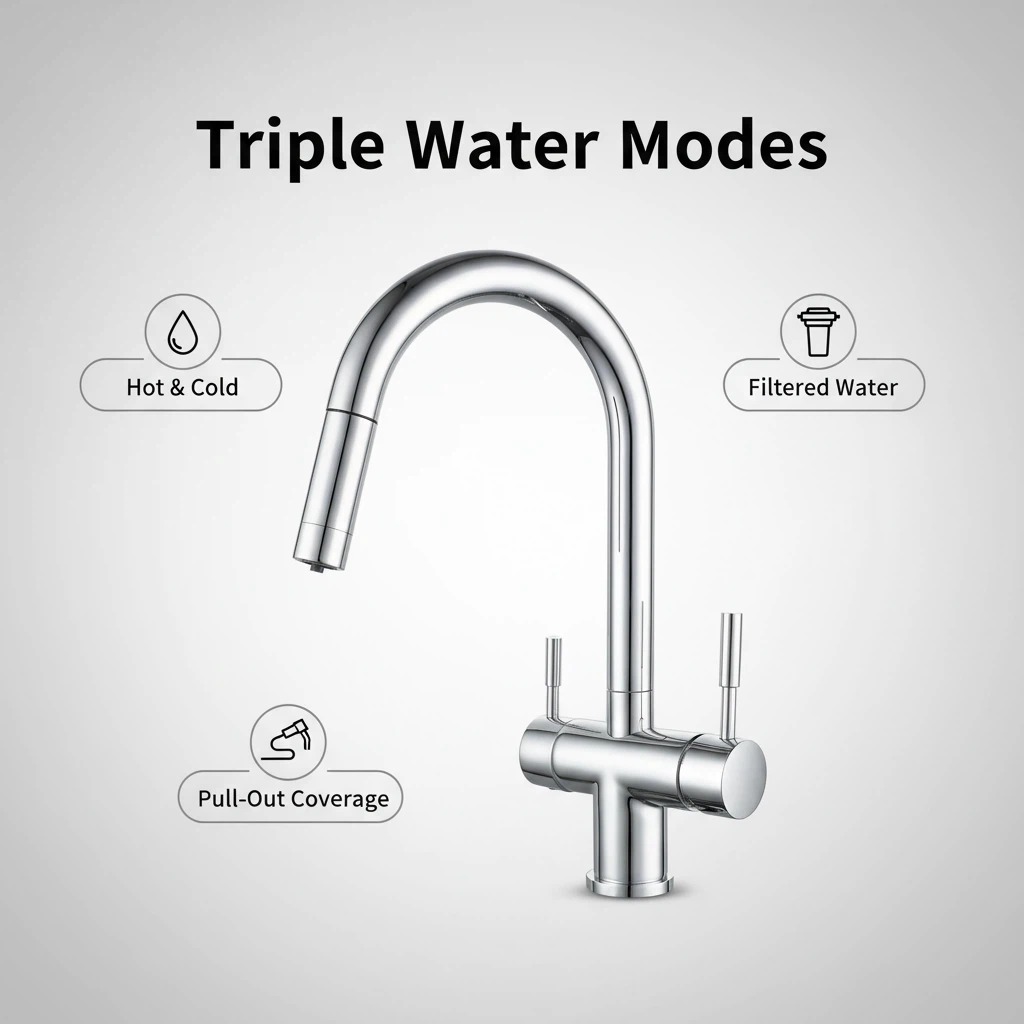
A 3 way kitchen faucet with filter, also called a 3-in-1 faucet, combines three water functions in one faucet body:
- Hot tap water
- Cold tap water
- Filtered drinking water
Unlike a standard filtered water faucet, a 3 way faucet does not require a second small faucet beside the main kitchen faucet. It uses separate internal water channels so filtered water does not mix with unfiltered tap water.
Compared with an ordinary kitchen faucet, a 3 way kitchen faucet with filter offers several advantages:
- Instant filtered water: No pitcher, bottle, or countertop filter needed.
- Space saving: No extra faucet hole required.
- Cleaner appearance: One faucet handles daily washing and drinking water.
- Better user experience: Many models use separate handles or buttons for filtered water.
- Modern design: Ideal for minimalist kitchens and smaller sink areas.
For many homeowners, this is the best-looking solution because it keeps the sink area simple and uncluttered.
Top 3 Kitchen Filtered Water Faucets in 2026
Evaluating a filtered faucet requires looking at material safety, daily user experience, and visual design. Here are the three standout models dominating the market in 2026.
1: Moen ChoiceFlow™ (Model: S72308EV)
Moen continues to lead the premium residential fixture market with its ChoiceFlow™ smart filtered series. This model focuses heavily on electronic convenience and high-end finishes.
- Pros: Features an intuitive LED indicator at the base that changes color to warn you when your under-sink filter life is running low. The dual-handle mechanics are crisp, and Moen’s proprietary Spot Resist™ stainless finish genuinely repels fingerprints and water spots.
- Cons: It sits at a premium price point, and the electronic filter indicator requires battery replacements every few months to stay active.
2: Kraus Purita™ (Model: KPF-3122)
The Kraus Purita™ is a dedicated standalone beverage faucet designed to complement your main faucet with a bold, industrial-modern aesthetic.
- Highlights: Built entirely out of heavy-duty, solid brass for extreme durability. It features a stunning high-arc spout that rotates 360 degrees, making it incredibly easy to fill tall stockpots, large thermoses, or blender pitchers right on your counter.
- User Experience: Users consistently praise the smooth, drip-free ceramic cartridge operation. The water stream is highly localized and splash-free, offering a commercial-grade feel in a residential kitchen.
3: Liliumfaucet 3-Way Pull-Down Filtered Faucet
Liliumfaucet has delivered a game-changer for 2026 by solving a classic industry problem: combining a 3-way filtered faucet with pull-out sprayer.
- Highlights: Constructed from premium, lead-free food-grade SUS304 stainless steel, ensuring zero chemical leaching into your drinking water. It features an advanced multi-stage carbon block filter integrated seamlessly beneath the sink. Unlike traditional stiff 3-way models, this fixture features a high-grade pull-out/pull-down spray hose, giving you total mobility across your entire sink basin.
- User Experience: The water flow rate for the filtered channel is remarkably fast, filling an 8oz glass in seconds. The brushed finish resists corrosion and is incredibly easy to wipe clean. The independent drinking water channel delivers a crisp, odorless taste, while the pull-down mechanical weight retracts smoothly every time.
To see how these specifications stack up against one another, check out the comparative data below:
| Features | Moen ChoiceFlow™ | Kraus Purita™ | Liliumfaucet 3-Way |
| Price Range | $350 - $450 | $130 - $180 | $220 - $280 |
| Type | 3-Way Integrated | Standalone Beverage | 3-Way Pull-Down Integrated |
| Material | Eco-Cheq Eco-Brass | Solid Brass Body | Premium SUS304 Stainless Steel |
| Filter Lifespan | 6 Months (750 Gallons) | System Dependent | 6 Months (800 Gallons) |
| Certifications | NSF/ANSI 42, 53 & 372 | NSF/ANSI 61 & 372 | NSF/ANSI 42, 53, 372 & cUPC |
| Installation | Single Hole Deck Mount | Single Hole (Secondary) | Single-Hole Deck Mount |
| Pull-Down | No | No | Yes (Flexible Braided Hose) |
How to Choose the Right Kitchen Filtered Faucet
The best filtered water faucet depends on your water quality, kitchen layout, and daily habits.
1. Choose the Right Water Outlet Style
Think about how you use your sink.
- Choose a separate filtered water faucet if you want a dedicated drinking water outlet.
- Choose a 3 way kitchen faucet with filter if you want one faucet for everything.
- Choose a pull-out faucet if you regularly rinse large pots, vegetables, or sink corners.
- Choose a RO-compatible faucet if you plan to install reverse osmosis.
2. Check Materials
Good faucet materials include:
- Stainless steel
- Lead-free brass
- Food-grade internal tubing
- Ceramic valve cartridges
For drinking water, avoid cheap faucets with unclear material information.
3. Look at Certifications
Certification matters more than broad marketing claims.
Useful standards may include:
- NSF/ANSI/CAN 61 for drinking water contact materials
- NSF/ANSI/CAN 372 for lead content
- NSF/ANSI 42 for taste, odor, and chlorine reduction
- NSF/ANSI 53 for certain health-related contaminants
- NSF/ANSI 58 for RO systems
- CE or local plumbing certifications where applicable
Remember: the faucet and the filter are two different parts. A safe faucet should use drinking-water-safe materials, while the filter should be certified for the contaminants you care about.
4. Consider Filter Replacement
A great faucet is less useful if the filter is hard to replace. Before buying, check:
- Cartridge cost
- Replacement interval
- Availability of replacement filters
- Whether the filter can be changed without tools
- Whether the system has a filter life indicator
Most household filters need replacement every 3-6 months, but RO membranes may last longer depending on the system.
Installation Tips
Many filtered water faucets can be installed by experienced DIY homeowners, but the difficulty depends on the product type.
Basic installation steps:
- Turn off the water supply under the sink.
- Remove the old faucet or prepare the mounting hole.
- Install the faucet body and tighten the mounting hardware.
- Connect hot and cold lines if using a 3 way faucet.
- Connect the filtered water line from the filter system.
- Check that tubing is fully inserted and secure.
- Turn water back on slowly.
- Check all joints for leaks.
- Flush the filter according to the manufacturer’s instructions.
Common issues to watch for:
- Wrong adapter size
- Not enough under-sink space
- Tubing bent too sharply
- Missing rubber washer
- Loose compression fitting
- Confusing filtered water line with cold tap line
Safety tips:
- Do not overtighten plastic fittings.
- Use only drinking-water-safe tubing.
- If drilling stone or quartz countertops, hire a professional.
- For RO systems with drain lines or air-gap requirements, follow the manual carefully.
Maintenance and Filter Replacement
A filtered faucet system only performs well when it is maintained.
Maintenance checklist:
- Replace filter cartridges every 3-6 months, or as recommended.
- Replace RO prefilters on schedule.
- Clean the faucet exterior with mild soap and a soft cloth.
- Remove mineral buildup around the spout.
- Flush the system after vacations or long periods of non-use.
- Check under-sink connections for leaks.
- Replace old or discolored tubing.
To reduce bacteria and scale:
- Keep the spout clean and dry.
- Do not touch the outlet with dirty hands or food.
- Sanitize the filter system according to the manual.
- Replace filters sooner if water taste, odor, or flow changes.
FAQ
Can a 3 way kitchen faucet with filter provide safe drinking water?
Yes, it can provide safe drinking water when connected to a properly certified filtration system. The faucet delivers the water, but the filter system removes or reduces impurities. For best results, choose a faucet with separate filtered water channels and connect it to a filter certified for your water quality needs.
How often should I replace the filter cartridge?
Most filter cartridges should be replaced every 3-6 months. The exact schedule depends on water quality, household size, water usage, and filter type. If the water flow slows down or the taste changes, replace the filter sooner.
Can I install it myself?
Yes, many homeowners can install a filtered water faucet themselves, especially if the sink already has a mounting hole. A 3 way faucet or RO system may take more time because there are more water lines to connect. Always follow the instruction manual, and call a plumber if drilling or complex plumbing is required.
What is the best water filtration system for a kitchen faucet?
For basic taste improvement, a carbon under-sink filter is often enough. For lead, PFAS, heavy metals, or dissolved solids, choose a certified system matched to those contaminants. For the highest purification level, a reverse osmosis system is often the strongest choice, but it costs more and may have slower flow.
Why am I thirsty after drinking reverse osmosis water?
RO water has very low dissolved mineral content, so some people feel it tastes “flat” or less satisfying. This does not mean the water is unsafe. If you prefer a fuller taste, consider a remineralization filter after the RO system. If excessive thirst continues, it may be unrelated to the water and worth discussing with a health professional.
Are faucet filters better than bottled water?
For many homes, filtered tap water is more convenient, less expensive over time, and produces less plastic waste than bottled water. Bottled water can still be useful during emergencies or when tap water is unsafe, but a good certified filtration system is often the better daily solution.
Does anyone know about 3-in-1 faucets or built-in filtration kitchen faucets?
Yes. A 3-in-1 faucet, also called a 3 way faucet, combines hot, cold, and filtered water in one kitchen faucet. Built-in filtration faucets are popular because they save space, look cleaner, and remove the need for a separate drinking water faucet. The key is to make sure the filtered water has its own internal channel and that the connected filter system is properly certified.
Conclusion
The best kitchen filtered water faucet in 2026 depends on what you value most.
Investing in a kitchen filtered water faucet is one of the most impactful upgrades you can make for your home in 2026. Whether you choose a dedicated standalone beverage tap like the Kraus Purita or opt for the ultimate space-saving efficiency of a Liliumfaucet 3-way pull-down model, you are making a conscious choice to prioritize your family's health, cut down on plastic waste, and elevate your kitchen's daily functionality.
By eliminating the clutter of countertop pitchers and the ongoing expense of bottled water, these integrated systems deliver crisp, purified water exactly when you need it. As you choose the right fixture for your space, remember to focus on lead-free materials, verified NSF certifications, and a design that complements your culinary workflow. With the right choice, pure and refreshing hydration will always be just a single touch away.
.jpeg?w=800&h=800)
.jpg?w=375&h=247)