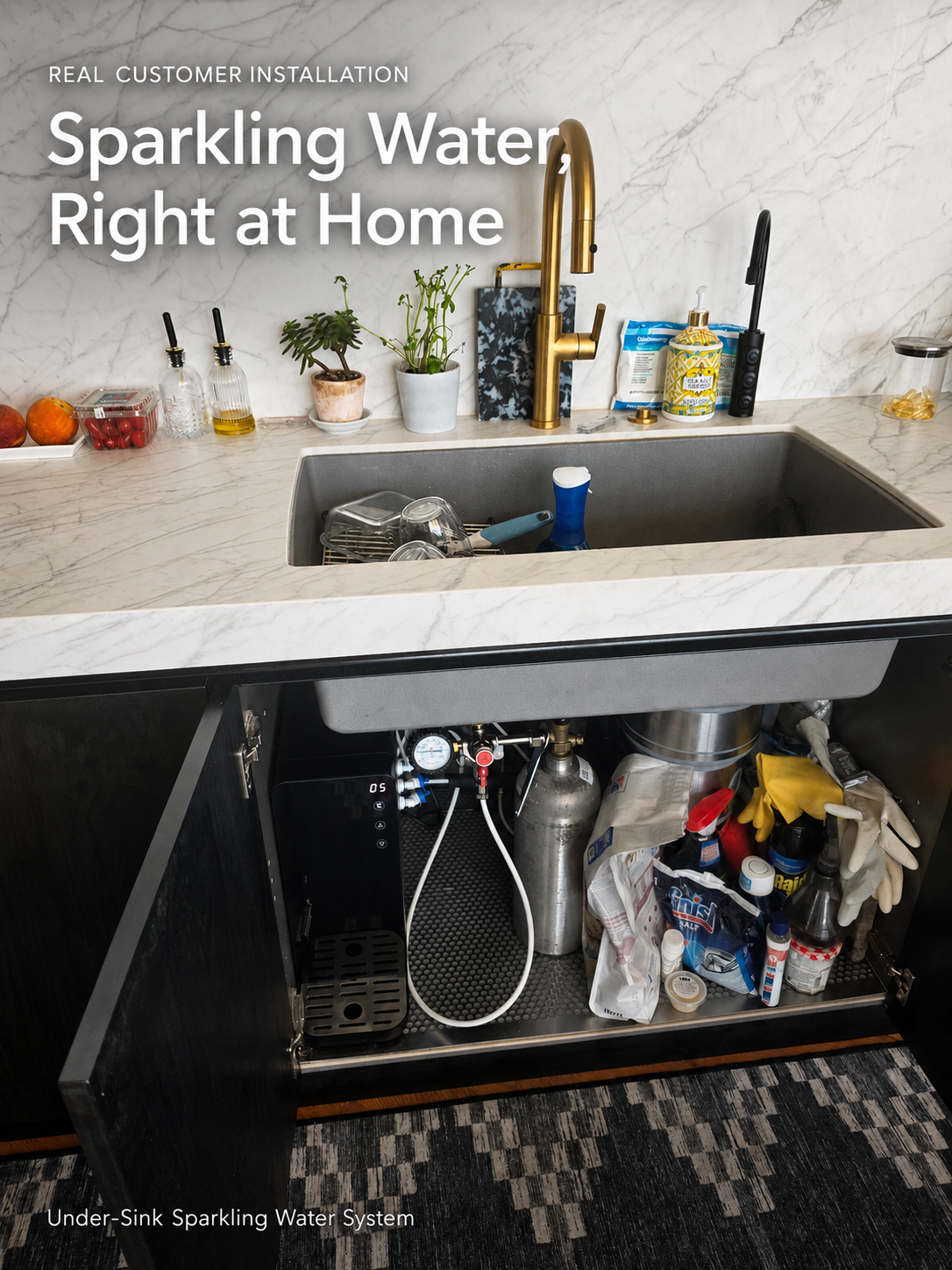
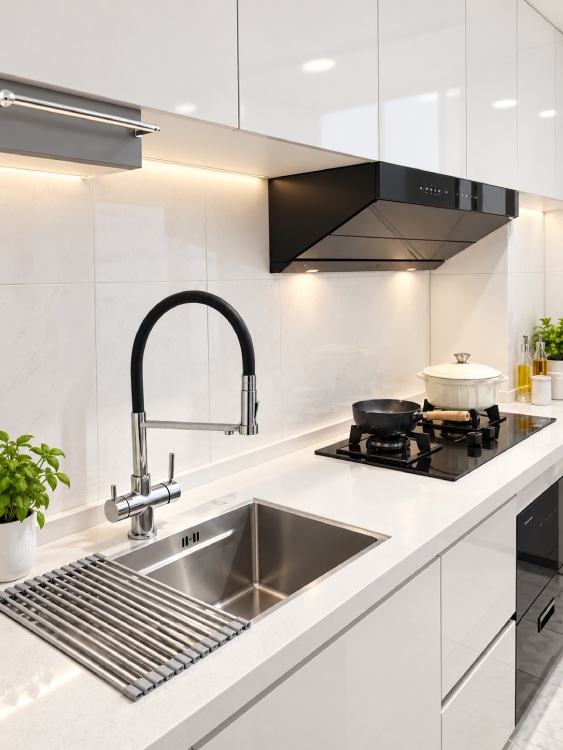
A sparkling water machine is easy to picture in a new kitchen. Finding the right place for it in the kitchen you already use takes a little more thought.
Perhaps your counter is already shared by a coffee maker, toaster and drying rack. Or there is plenty of counter space, but the cabinet beneath the sink is crowded with a garbage disposal, cleaning supplies and plumbing. You might love your current kitchen faucet and have no interest in replacing it.
These details matter when choosing between a countertop sparkling water machine and an under-sink system. So does the way you drink. Making sparkling water occasionally with dinner is a different routine from having several people stop by the kitchen for a glass throughout the day.
Before comparing features, it helps to separate countertop equipment into two groups: SodaStream-style makers that carbonate water in a compatible container, and dispensers that let you fill a glass directly from the machine. Under-sink systems provide another direct-dispensing option, with the equipment inside the cabinet and a faucet above .
Here is how those choices fit into an everyday kitchen.
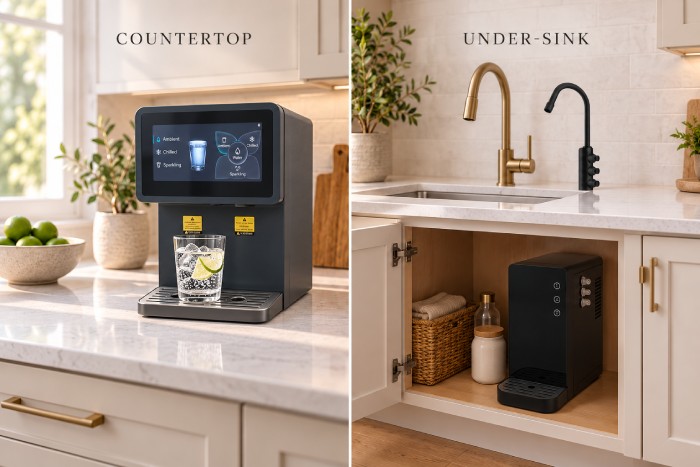
First, Know Which Type of Countertop Machine You Are Comparing
“Countertop sparkling water maker” can describe quite different appliances. That makes some comparisons confusing before they even get started.
SodaStream-Style Sparkling Water Makers
With a typical SodaStream-style maker, you fill a compatible carbonating bottle, attach it to the machine, carbonate the water and then pour it into a glass.
The appeal is straightforward. Many manual models need neither a water connection nor an electrical outlet, making them easy to position or move. For someone who wants to make sparkling water without changing the kitchen, that flexibility is useful.
There is a preparation step each time, though. You need water ready to carbonate, a clean compatible bottle and enough CO₂. If you like your water cold, common models rely on you providing chilled water.
For an occasional drink, the process may fit comfortably into your routine. When several people want separate refills throughout the day, the repeated filling and carbonation steps become more noticeable.
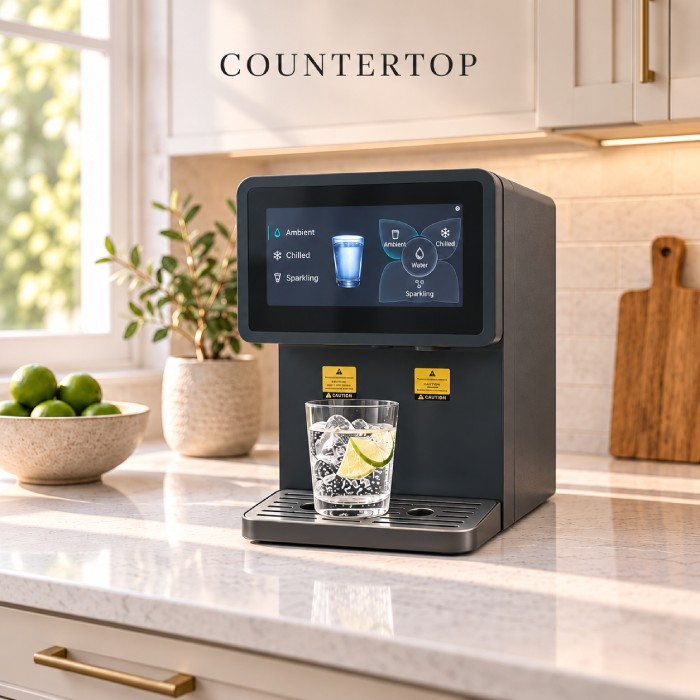
Countertop Sparkling Water Dispensers
A countertop dispenser keeps the machine above the counter and lets you collect sparkling water directly from its outlet.
This is a different experience from attaching a bottle for each batch. Place a glass beneath the outlet, operate the control and dispense your water.
How the machine receives water still matters. Some models have a refillable reservoir; others connect to a water supply. Cooling, filtration and CO₂ arrangements also vary.
That means a countertop dispenser is not automatically an installation-free appliance. A reservoir model may avoid plumbing work, while a plumbed model needs a practical route for its supply tubing.
Under-Sink Sparkling Water dispenser
An under-sink sparkling water system puts the main equipment inside a cabinet and delivers water through a connected faucet.
You collect water at the sink while the machine stays below. Depending on the setup, the outlet may be a separate drinking-water tap or part of a compatible multifunction kitchen faucet.
The attraction is easy to understand if you prefer clear worktops. The trade-off is that the equipment still needs space, along with suitable water connections, power where required, CO₂ and ventilation.
What Will Fit in Your Existing Kitchen?
Start with the space you actually have. Product photos rarely show the drainpipe, disposal unit or collection of appliances that will share the area with your new system.
Look Beyond the Countertop Footprint
For a countertop machine, width and depth are only the beginning.
Check whether there is enough clearance beneath upper cabinets to refill a reservoir, operate the machine and access its CO₂ compartment. A unit might fit neatly under a cabinet but need to be pulled forward whenever you refill it.
With a direct dispenser, check the space beneath the outlet too. Your everyday glass may fit easily, while a tall reusable bottle may not.
If the machine connects to a water line, work out where that line will run. A countertop location does not remove the need to plan plumbing.
Measure the Usable Cabinet Space
Under the sink, measure around existing fittings rather than treating the cabinet as an empty box.
A garbage disposal can occupy much of one side. Drainpipes may block the back. Pull-out bins and storage drawers can interfere with tubing or access to the machine.
Allow room for the complete setup:
- The main unit and its required ventilation clearances.
- The CO₂ cylinder, regulator and connections.
- Any required drinking-water filter.
- Tubing routes and access to shutoff valves.
- Space to replace filters and remove the cylinder.
An installation that fits tightly on day one may be frustrating when something needs routine attention. Being able to reach the equipment is part of a good layout.
Check North American Connections Before Ordering
For US and Canadian kitchens, confirm the selected unit’s electrical requirements and the fittings needed for your existing supply.
A product intended for the North American market may still require adapters to suit your particular plumbing or filter arrangement. Check the complete connection path rather than assuming everything will connect directly.
Clear photos of the cold-water shutoff, filter connections and cabinet interior can help a supplier identify what is needed before delivery.
Can You Keep Your Existing Kitchen Faucet?
Often, the answer is yes—if you choose a compatible system with a separate drinking-water tap.
This is worth considering when your main faucet already suits the kitchen and works well.
Adding a Separate Sparkling Water Tap
A dedicated drinking-water tap allows the existing faucet to continue handling ordinary hot and cold water. The additional tap serves the water functions provided by the connected system.
An unused sink or countertop hole may offer a convenient location, provided its diameter, position and surrounding space meet the new tap’s requirements.
Without a suitable opening, you will need to plan one. For stone or other specialist countertop materials, confirm the work with an appropriate installer before ordering.
Also consider where the water will land. An outlet positioned over the sink makes everyday drips easier to manage. Check that the spout reaches far enough and leaves comfortable room for your usual cups.
Matching the Faucet to the Kitchen
The two faucets do not necessarily need identical finishes.
Matching finishes can make the sink area feel consistent. A contrasting drinking-water tap can work just as well when it relates to other details in the room. For example, a compact black tap beside a brass main faucet may pick up black cabinet handles, lighting or window frames.
Proportion matters as much as color. A smaller drinking-water tap can sit beside a larger kitchen faucet without making the sink area feel crowded.
Choosing a Multifunction Faucet
A compatible multifunction faucet offers another approach: bringing the required water outlets into one fixture.
This may suit a kitchen where you want fewer fixtures around the sink or are already replacing the main faucet.
Read the actual water functions and connection requirements carefully. Terms such as “3-way,” “4-way” and “5-way” are not a substitute for checking what a particular model delivers. Confirm whether it supports filtered ambient water, chilled water, sparkling water and ordinary hot and cold water in the combination you need.
A standard kitchen faucet should not be assumed suitable for connection to a sparkling water system.
How Does Each Option Feel to Use Every Day?
Installation happens once. Filling a glass happens repeatedly, so the small steps deserve attention.
With a SodaStream-style maker, you prepare and carbonate water before pouring it. Some households enjoy making a batch and keeping it nearby for a meal.
A countertop direct dispenser removes that batch-making step. You take a glass to the machine and dispense. If it uses a reservoir, refilling that reservoir becomes part of the routine.
With a plumbed under-sink system, you collect water at the connected faucet. There is no countertop reservoir to carry to the sink, although filters and CO₂ still need attention.
Think about where you naturally reach for drinking water. If everyone already uses the sink area to fill glasses, a sparkling water tap fits that habit. If you have a separate beverage counter with plenty of room, a countertop dispenser may sit comfortably alongside your coffee equipment.
Neither arrangement needs to be complicated. The better fit is the one whose small daily tasks you are happy to live with.
If You Want Cold Sparkling Water, Check the Cooling Function
Carbonating cold water and actively chilling water are different functions.
With many SodaStream-style machines, you chill the water beforehand. Countertop direct dispensers and under-sink systems may include refrigeration, but you need to confirm that for the model you are considering.
Also look beyond the temperature setting. Ask how much chilled sparkling water the unit can deliver before it needs time to recover.
This becomes noticeable when you fill several glasses in succession. A system that comfortably supplies one cold glass may behave differently when asked to fill a large pitcher.
For a fair comparison, check the temperature, dispensing capacity and recovery guidance together.
Will the Water Output Be Enough for Your Family?
Household size is useful context, but it does not tell the whole story.
Two people who regularly fill large bottles may place more demand on a system than four people who each have one small glass with dinner.
The most helpful question is: What happens during your busiest few minutes?
Picture a normal evening. Perhaps one person fills a glass while cooking, then three more people want water with dinner. Or perhaps you usually drink alone but host friends every weekend.
Describe that pattern when asking about a machine’s capacity.
Separate Hourly Production From One-Time Dispensing
An hourly production figure does not necessarily mean you can collect that entire quantity in one uninterrupted pour.
When comparing specifications, ask about:
- Recommended dispensing volume: how much to collect in one session.
- Hourly production: the amount the unit can produce under stated conditions.
- Recovery time: the wait after repeated dispensing.
- Test conditions: especially incoming water temperature and ambient temperature.
“Can it fill four 12-ounce glasses one after another?” is a more useful buying question than “Is it suitable for a family?”
Direct dispensing is convenient, but every system has operating limits. Choosing around your real usage helps avoid disappointment.
CO₂ and Filtration Need a Place in the Plan
The main unit is only part of the setup.
Before buying, confirm the required CO₂ cylinder type, connection and regulator, as well as where you can obtain exchanges or refills locally. Do not assume a cylinder from an existing machine will fit a new system.
If the cylinder will sit in a cabinet, make sure you can access and remove it without dismantling the installation. Follow the equipment instructions for positioning and securing it.
Filtration also needs to match the selected system. Some appliances include treatment; others require a separate drinking-water filter.
For a Liliumfaucet under-sink setup, plan for a suitable drinking-water filter before the machine inlet. Include its space, fittings and replacement access in the cabinet layout.
If you already have reverse osmosis filtration, check compatibility with the supplier. The suitability of the water supply and filter output should be confirmed for the specific equipment rather than assumed.
Which Setup Makes the Most Sense?
By this point, the choice usually becomes clearer.
| Your priority or kitchen condition | A useful starting point |
|---|---|
| Minimal changes to the kitchen; comfortable preparing each batch | SodaStream-style maker |
| Direct dispensing with space available on the counter | Countertop sparkling water dispenser |
| Clear worktops and a suitable cabinet below | Under-sink sparkling water system |
| Keeping an existing main faucet | Compatible system with a separate drinking-water tap |
| Replacing the main faucet and reducing separate fixtures | Compatible multifunction faucet arrangement |
| Filling several glasses close together | Compare specific dispensing and recovery figures across models |
A countertop setup can be a good long-term choice. An under-sink system can be a practical upgrade to an existing kitchen. What matters is whether the installation and everyday operation suit your home.
Frequently Asked Questions
Do countertop sparkling water dispensers need plumbing?
Some do; others use refillable reservoirs. Check the selected model’s water supply requirements, along with power, CO₂ and any drainage requirements.
Can I install an under-sink system without replacing my kitchen faucet?
A system designed for a separate drinking-water tap can allow you to keep the existing main faucet. You will need a suitable mounting location and compatible connections.
Do I need to drill a new hole?
You may be able to use an existing opening if it meets the faucet’s installation requirements. Otherwise, a new opening or a compatible replacement faucet arrangement may be necessary.
Can an under-sink sparkling water system fill several glasses in a row?
That depends on the model, serving size and operating conditions. Ask for the recommended consecutive dispensing volume and recovery time, especially if chilled water is important to you.
Is under-sink sparkling water always colder or fizzier?
Installation position alone does not determine temperature or carbonation. Those depend on the machine’s design, settings, water conditions and correct installation.
Before You Choose, Check the Installation
The most useful first step is to look at your kitchen with the complete system in mind.
Measure the available space, photograph the existing water connections and decide whether you want to keep your current faucet. Then consider how much sparkling water you normally collect at one time.
If you are exploring a Liliumfaucet under-sink system, start by reviewing the installation requirements and required configuration: the machine, compatible faucet, drinking-water filter, CO₂ cylinder and regulator.
Getting those details right makes the final choice much easier—and gives you a setup that feels convenient once it becomes part of everyday life.