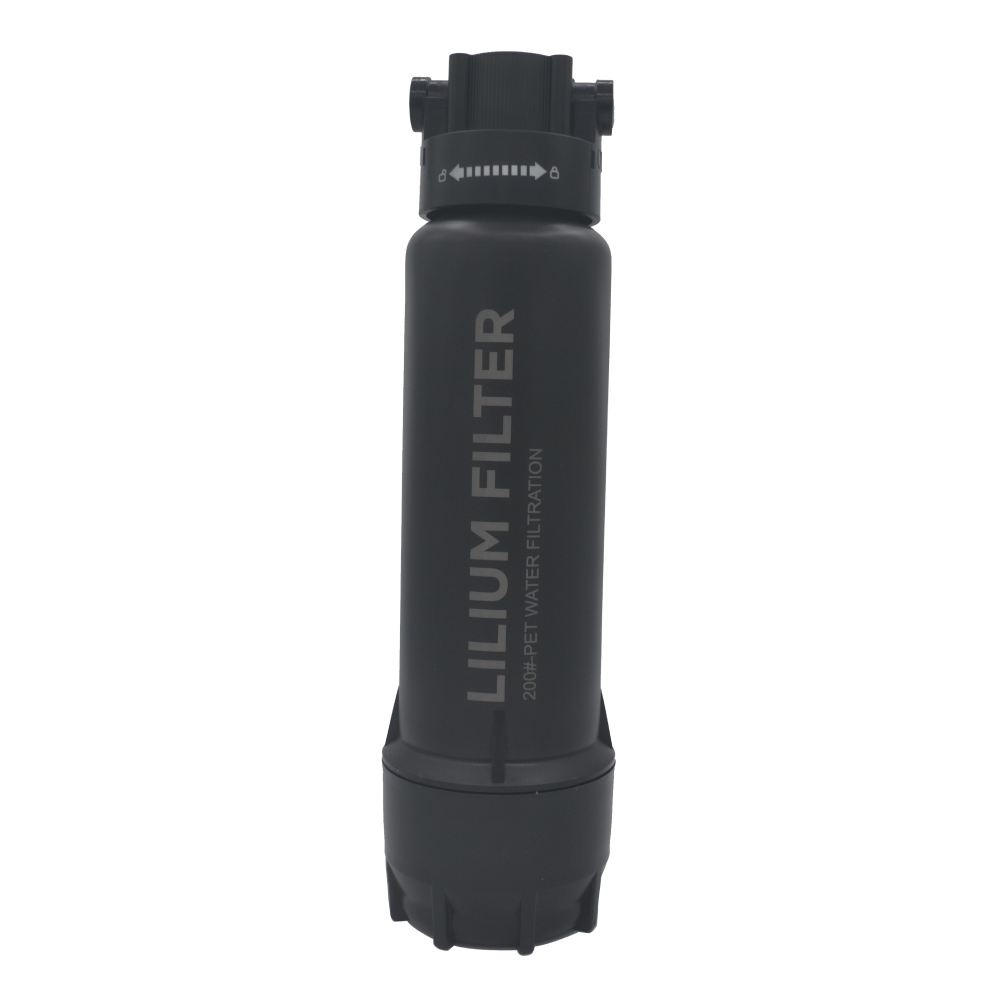
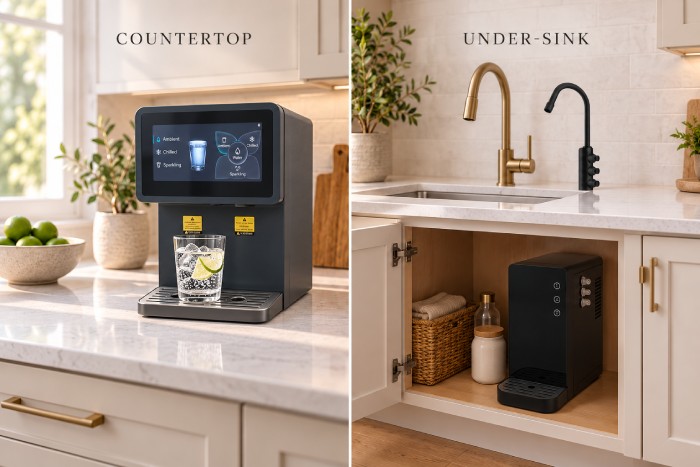
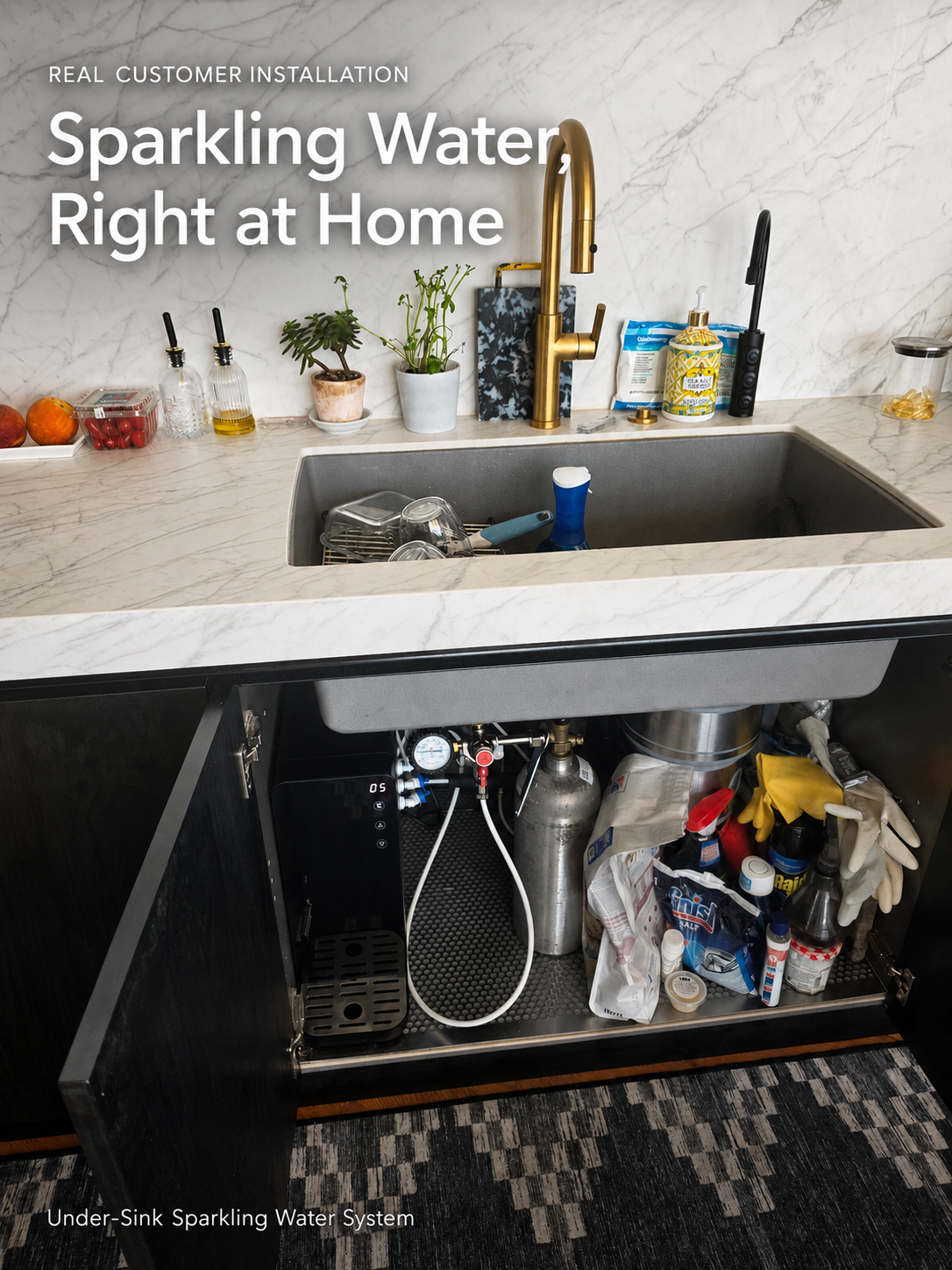
In many American and Canadian kitchens, the space beneath the sink is already occupied by a reverse osmosis (RO) water filtration system. There may be pre-filters, a booster pump, an RO membrane, a storage tank, or a tankless unit, along with a thin water line running to a dedicated drinking water faucet. Now, more households are looking to add an under-sink sparkling water dispenser alongside their existing filtration setup.
This raises a few practical questions: Can an RO system that's been in use for three to five years connect directly to a new sparkling water dispenser? Do you need to replace it with a filtration system recommended by the dispenser manufacturer?
The short answer is yes, you can use RO water with a Liliumfaucet sparkling water dispenser. However, before installation, you need to confirm four things: the connection size, actual water pressure after filtration, actual water flow rate, and whether the water meets drinking water standards. If any of these requirements are not met, the system may be physically connected but may not operate properly.
This article follows the same order you would normally approach purchasing and installation. We'll start with what RO filtration is and how it relates to the water quality requirements of sparkling water. Then we'll cover compatibility, pressure and flow rate, tank and tankless systems, installation steps, and common mistakes.
If you just want a practical way to determine compatibility, you can jump directly to the flow rate testing section.
1. What Is an RO Water Filtration System?
RO stands for Reverse Osmosis. Unlike a traditional sediment filter or activated carbon filter that traps certain impurities, reverse osmosis uses a semipermeable membrane. Under pressure, water molecules pass through the membrane while dissolved salts, certain heavy metals, particles, and larger molecules are separated and carried away through the wastewater line.
A typical residential under-sink RO system consists of four main stages.
The sediment and carbon pre-filters remove particles and reduce chlorine to protect the membrane. A booster pump increases water pressure to the level required for membrane operation. The RO membrane performs the main filtration process, typically with a salt rejection rate of 90%–99%. Finally, a post-carbon filter or remineralization cartridge improves the taste of the water.
Systems with a storage tank include an additional pressure tank, while tankless systems produce purified water on demand.
After RO treatment, the TDS (Total Dissolved Solids) level is usually much lower than that of the original water supply. This is why many people notice readings in the low double digits when testing RO water with a TDS meter.
The U.S. Environmental Protection Agency (EPA) identifies reverse osmosis as one of the technologies used for household drinking water treatment. The Centers for Disease Control and Prevention (CDC) also explains that RO systems remove certain minerals along with contaminants.
Together, these points help explain an important consideration we'll discuss later: why achieving the lowest possible TDS reading should not automatically be your goal.
It's also important to understand the limitations of reverse osmosis.
RO is not a universal solution for every water quality problem. Certain small organic compounds, residual chlorine, and microbial risks may require activated carbon, UV treatment, or other specific treatment methods. Actual contaminant removal depends on the membrane, the overall system design, and third-party certifications, such as NSF/ANSI 58 for reverse osmosis systems.
In other words, having an RO system installed does not automatically guarantee that your drinking water meets every applicable standard. You still need to verify its performance.
1.1 Why Does Water Quality Matter for Sparkling Water?
Because sparkling water is intended for direct consumption, not for washing vegetables or cleaning dishes.
A sparkling water dispenser is responsible for chilling and carbonating water. It is not designed to purify or disinfect the incoming water.
Filtration must take place before water enters the machine. This is sometimes misunderstood, especially when users see internal water lines or filters inside the dispenser.
Proper filtration offers three practical benefits for sparkling water.
First, it can improve taste and odor. Carbonation changes how we perceive flavors and aromas, and chlorine or metallic tastes may become more noticeable in sparkling water.
Second, an appropriate filtration system can reduce specific contaminants, depending on its filtration technology.
Third, it helps ensure that the water entering the dispenser consistently meets drinking water requirements.
Liliumfaucet sparkling water systems are designed to use appropriately filtered drinking water.
This is why we require a suitable filtration system upstream of the dispenser. Filtration determines the quality of the water you drink, while the dispenser determines how that water is served.
2. Which RO Brands Are Compatible With Liliumfaucet?
This is one of the most common questions customers ask before purchasing, and it's also one of the easiest to misunderstand.
2.1 Do You Need a Specific RO Brand?
No. We do not require customers to use a particular brand of reverse osmosis system.
Brand name is not the main factor in determining compatibility.
Regardless of which RO system you currently own, the same considerations apply:
- Does the water connection fit?
- Is the filtered water pressure sufficient?
- Can the system provide the required flow rate?
- Is the filtered water suitable for direct consumption?
We do not maintain a list of guaranteed compatible RO models, and there's a practical reason for that.
Water filtration manufacturers regularly update their products. Even within the same brand, different generations or models may use different connections, water delivery mechanisms, or restrictions on connecting additional equipment.
Listing an untested model as compatible would create an expectation we cannot reasonably guarantee.
Instead of choosing based on brand alone, we recommend checking the four compatibility requirements discussed in this article.
2.2 Is a 1/4-Inch Connection a Universal Standard?
Liliumfaucet uses a standard 1/4-inch outer diameter (OD) water tube with a quick-connect fitting.
This is one of the most common tubing sizes used in under-sink water filtration systems.
Most RO systems that use standard 1/4-inch tubing are relatively straightforward to connect. The installation usually involves cutting the tubing squarely, inserting it into the fitting, and securing the locking clip. No soldering or specialized tools are required.
However, there are two exceptions worth checking before installation.
The first is an RO system that uses 3/8-inch tubing or a proprietary connection. In these cases, an appropriate adapter may be necessary.
The second is more important: some RO manufacturers do not allow users to split the purified water outlet to supply additional appliances.
These restrictions are usually explained in the installation manual or warranty terms. They may relate to pressure switch operation, water flow distribution, or warranty responsibilities.
Checking the manufacturer's instructions before installation is much easier than dealing with compatibility problems afterward.
Also, remember that the 1/4-inch water connection is not the CO₂ connection.
The 1/4-inch tubing is used for the filtered water inlet, while Liliumfaucet uses 5/16-inch tubing for CO₂.
These are two completely separate lines. Do not interchange them, and never connect the CO₂ supply to the water inlet.
3. Is Reverse Osmosis the Best Water Filter for Sparkling Water?
Not necessarily. It depends on your water quality and what you need from your filtration system.
There are two questions that are often confused: Can RO water be carbonated, and does RO water produce sparkling water that tastes good?
3.1 Why We Don't Recommend Extremely Low-TDS RO Water as the First Choice
Let's address a common misconception first.
Some people believe that RO water is too pure for CO₂ to remain dissolved, making it difficult or impossible to produce sparkling water.
This explanation is not technically accurate.
Carbonation depends on factors such as CO₂ pressure, water temperature, gas-liquid contact time, and the operating conditions of the equipment. It does not depend solely on the TDS level of the water.
The more noticeable difference is often in taste rather than carbonation.
Reverse osmosis removes minerals such as calcium and magnesium. Without these minerals, water may taste lighter or flatter.
For households accustomed to mineral-rich drinking water, switching to highly purified RO water can make sparkling water taste less distinctive.
Their first reaction may be that the water tastes bland, rather than that it lacks carbonation.
This is a matter of personal taste, not necessarily a problem with the sparkling water dispenser.
For this reason, we do not recommend choosing an extremely low-TDS RO system simply to achieve the lowest possible reading.
Instead, start by understanding your local water quality.
In the United States, homeowners can review their water supplier's annual Consumer Confidence Report. In Canada, municipal water quality reports provide similar information.
Look at factors such as hardness, residual chlorine, nitrates, and TDS before deciding whether RO filtration is necessary or whether a remineralization stage would be useful.
3.2 RO vs. Standard Under-Sink Water Filters: Which Should You Choose?
| Water Filtration Type | Main Characteristics | Our Recommendation for Liliumfaucet |
|---|---|---|
| Standard under-sink drinking water filter (activated carbon, ultrafiltration, or multi-stage filters) | Reduces chlorine, unpleasant odors, certain organic compounds, and particles depending on the filter media. Usually retains natural minerals. | Consider a model suitable for your local water quality. Many can supply water directly to the dispenser. |
| Reverse osmosis (RO) system | Significantly reduces dissolved salts, certain heavy metals, and TDS, while also removing minerals. | Compatible when the filtered water pressure and flow rate meet the dispenser's requirements. |
| RO system with remineralization | Adds a remineralization cartridge after the RO membrane to restore some calcium and magnesium. | Worth considering, but verify filtration performance, actual mineral content, and any impact on pressure or flow rate. |
| Extremely low-TDS RO system | Produces water with very low mineral content, which may taste relatively flat. | Not our default recommendation. First determine whether this level of purification is necessary. |
The purpose of this comparison is not to rank one filtration technology above another.
For a sparkling water dispenser, safe drinking water and a stable water supply matter more than simply achieving a lower TDS number.
The filtration technology should serve those goals, not the other way around.
4. What Water Pressure and Flow Rate Does a Sparkling Water Dispenser Need?
This is the most important section if you're planning an installation.
The following specifications are the filtered water inlet requirements for Liliumfaucet sparkling water dispensers.
Measurements should be taken after the filtration system, not at the home's main water supply.
| Parameter | Requirement | Notes |
|---|---|---|
| Filtered water inlet pressure | 30–45 PSI (approximately 2–3 bar) | Measure while water is flowing. Static pressure alone is not sufficient. |
| Minimum inlet flow rate | ≥ 1 L/min (approximately 0.26 US gal/min) | Measure actual flow over 60 seconds. |
| Filtered water inlet tubing | 1/4-inch OD quick-connect | Compatible with many standard under-sink filtration systems. |
| CO₂ connection tubing | 5/16-inch | Separate gas supply line, not part of the water inlet. |
4.1 Why "My Home Has Enough Water Pressure" Is Often Misleading
An RO membrane creates resistance, and the filtration process involves a pressure drop.
Many homes have incoming water pressure around 50–60 PSI, but the pressure available after an RO system may be much lower, sometimes dropping to 20–30 PSI.
This is why having sufficient household water pressure does not necessarily mean the RO outlet can provide enough pressure for a sparkling water dispenser.
Insufficient pressure can slow down water replenishment and interrupt the dispenser's normal operating cycle.
Excessive pressure is not ideal either.
Some RO systems with booster pumps and inadequate pressure regulation may expose the dispenser's inlet valve to unnecessarily high pressure.
The recommended 30–45 PSI range is not a case where higher is always better.
4.2 Why Water Flow Rate Matters More Than Most People Think
A sparkling water dispenser needs a continuous supply of filtered water to replenish the water used during operation.
If you dispense 1–2 liters of sparkling water continuously, the upstream filtration system must be able to replenish the required water over the corresponding operating period.
RO systems are commonly rated in gallons per day (GPD).
For example, a 600 GPD system sounds powerful. In theory, that corresponds to approximately 2.3 liters per minute.
However, this rating is generally based on specified test conditions, including water temperature, inlet pressure, and TDS.
Actual performance can be lower.
Cold incoming water during winter, high feed-water TDS, or additional resistance from post-filters can all reduce the water delivery rate.
This is why you cannot rely on the advertised GPD rating alone to determine whether an RO system can support a sparkling water dispenser.
Common signs of insufficient flow include:
- Intermittent sparkling water dispensing.
- Frequent water replenishment cycles.
- Noticeably slower dispensing when filling a second glass.
- An E4 water replenishment protection error in more severe situations.
However, E4 should not automatically be attributed to the RO system.
Other possible causes include water level sensors, inlet valves, or air trapped in the water lines.
Think of E4 as a signal to check the upstream water supply, rather than a final diagnosis.
4.3 How to Test Your RO System's Actual Water Flow and Pressure
You can perform a basic flow test before installing the sparkling water dispenser.
Step 1: Measure at the filtered water outlet.
Collect water from the filtration system's purified water outlet.
Do not measure from the sparkling water faucet. Also, avoid using the RO system's small dedicated drinking water faucet if its outlet size restricts the flow.
Step 2: Use a measuring container and timer.
Measure how much water is delivered over 60 seconds.
The minimum target is 1 liter.
If your system delivers between 0.8 and 1 liter per minute, it is close to the minimum requirement. You should first reduce unnecessary tubing resistance or improve the supply conditions before connecting the dispenser.
Step 3: Repeat the test after continuous water flow.
Allow the system to dispense water for 2–3 minutes, then repeat the measurement.
This is particularly important for RO systems with storage tanks.
You want to understand whether the system can maintain water delivery after the stored water has been used, rather than relying only on the flow rate when the tank is full.
Step 4: Check pressure while water is flowing.
If possible, measure the water pressure under flowing conditions.
A pressure reading taken with the outlet closed may give a misleading impression of the system's actual supply capability.
If necessary, ask a qualified installer to measure dynamic pressure.
How to interpret the results:
-
Both flow rate and pressure meet the requirements: The system can be connected using an appropriate 1/4-inch tee fitting, provided the RO manufacturer permits the connection. Make sure all fittings are secure and check for leaks.
-
Flow rate is borderline and pressure is low: Check whether the pre-filters need replacement, whether tubing is bent or compressed, and whether the storage tank's pre-charge pressure is correct. Many RO pressure tanks require approximately 7–8 PSI when empty. Correcting these issues may be enough to restore adequate supply.
-
Flow rate or pressure is significantly insufficient: Consider whether a storage tank, higher-capacity RO membrane, or booster pump would be appropriate. Any modification must comply with the RO manufacturer's installation requirements. Do not add components without checking compatibility.
5. Tank vs. Tankless RO Systems: Which Works Better?
5.1 RO Systems With a Storage Tank
A traditional tank RO system stores several liters of purified water for later use.
When water is needed, the storage tank provides an immediate supply, which can be useful when dispensing multiple glasses in succession.
To determine whether a tank RO system is suitable, check three factors:
- Usable water storage capacity.
- Water delivery pressure.
- Sustained flow rate as the tank empties.
As the storage tank approaches empty, its water delivery capability may decrease.
This is a normal characteristic of the system, not necessarily a malfunction.
When selecting a storage tank, consider how much sparkling water your household may dispense at one time.
If you regularly fill two large glasses in a row, the tank's usable capacity should be sufficient for that demand rather than just one serving.
5.2 Tankless RO Systems
Tankless RO systems produce purified water on demand.
They are generally more compact beneath the sink and eliminate the need for a separate storage tank, along with concerns associated with water storage.
They have also become an increasingly popular option in modern kitchens.
However, actual water delivery rates vary significantly between models.
A high advertised GPD rating does not automatically mean a tankless system can support a sparkling water dispenser.
There is another important point to confirm before installation: whether the RO manufacturer allows the filtered water outlet to be split.
Tankless RO systems often use pressure switches, flow sensors, and electronic controls to manage water production.
Adding an unauthorized branch connection may cause frequent starting and stopping, affect the RO system's service life, or create unstable water delivery to the sparkling water dispenser.
The conclusion is straightforward.
Both tank and tankless RO systems can potentially work with Liliumfaucet sparkling water dispensers.
There is no need to recommend one type universally.
Actual water pressure and sustained flow rate at the filtered water outlet are what matter most.
6. Can You Install a Sparkling Water Dispenser Without an RO System?
6.1 Is a Water Filter Still Necessary?
You do not necessarily need an RO system, but you do need a suitable drinking water filtration system.
The reason is simple.
Sparkling water is consumed directly, and the dispenser itself is not a water purification device.
A standard under-sink filtration system, such as activated carbon, ultrafiltration, or a multi-stage filter, may be perfectly suitable under many water quality conditions.
The important thing is choosing a filter that addresses the actual water quality concerns in your area.
However, it is equally important not to assume that every activated carbon filter can remove every contaminant.
If your local water supply contains problematic levels of nitrates, arsenic, hardness minerals, or microbial contamination, a basic filter may not provide the required treatment.
In those cases, you should select a verified filtration solution designed to address the specific contaminants.
Reverse osmosis, potentially combined with additional treatment stages, may be a more appropriate choice.
6.2 Can You Continue Using Your Existing Under-Sink Water Filter?
If you already have an under-sink water filtration system, consider keeping it rather than replacing the entire setup just to install a sparkling water dispenser.
Check the following four things:
-
Filter replacement schedule: Make sure the cartridges have not exceeded their recommended service life. Old filters may not only lose filtration performance but can also become a place for microbial growth.
-
Filtered water outlet connection: A standard 1/4-inch outlet is straightforward to connect. A 3/8-inch or proprietary connection may require an adapter.
-
Actual pressure and flow rate: Use the testing method described earlier. Both measurements should be checked while water is flowing.
-
Manufacturer's installation instructions: Confirm that the filtration system allows a connection to additional equipment.
If all four requirements are satisfied, your existing filtration system should be capable of supplying the sparkling water dispenser.
7. How to Connect an RO System to a Liliumfaucet Sparkling Water Dispenser
The basic sequence for an under-sink installation is generally consistent.
Understanding the water supply path helps you identify where each connection belongs and whether to check the upstream or downstream components when troubleshooting.
7.1 Typical Under-Sink Installation Steps
Step 1: Turn off the cold water supply.
Close the kitchen's cold water shut-off valve and open the downstream faucet to release any remaining pressure and water.
This helps prevent water from spraying when you disconnect the tubing.
Step 2: Connect the filtration system to the cold water supply.
Install an appropriate tee fitting or diverter valve on the cold water line to supply the filtration system.
If an RO system is already installed, this connection is usually in place, so you can proceed to the next step.
Step 3: Connect the filtered water outlet to the sparkling water dispenser.
Use 1/4-inch food-grade water tubing to connect the purified water outlet to the dispenser's water inlet.
Cut the tubing squarely, insert it fully into the fitting, and make sure the locking clip is secured.
Step 4: Connect the CO₂ supply separately.
Connect a food-grade CO₂ cylinder to a compatible pressure regulator.
Then use the 5/16-inch CO₂ tubing to connect the regulator to the dispenser.
The water and CO₂ lines must remain separate. Never interchange their connections.
Step 5: Turn on the water and power supply, then test the system.
Allow water to flow through the system as required to remove trapped air.
Check every connection for leaks, and complete the installation of the sparkling water faucet.
Each step should produce an observable result.
After turning on the water supply, all connections should remain dry and leak-free.
During water replenishment, the machine should operate without unusual noises or frequent starting and stopping.
When dispensing two glasses of sparkling water consecutively, the carbonation level should not decrease noticeably.
If something does not perform as expected, start by checking the upstream supply rather than immediately assuming that the dispenser is defective.
The exact tubing layout and branch connections should always follow the installation instructions for your specific sparkling water dispenser and filtration system.
Valve and connection locations may differ between product generations.
7.2 Three Common Installation Mistakes to Avoid
Mistake 1: Connecting the dispenser directly to unfiltered water.
Some users connect the dispenser directly to the cold water line to simplify installation.
It may appear to work initially, but over time, water quality can affect internal components, valves, and the taste of the water.
Mistake 2: Checking the connection size but ignoring pressure and flow rate.
Matching fittings do not guarantee adequate water delivery.
This is one of the most common reasons a newly installed system may not perform as expected.
Mistake 3: Choosing an RO system without considering shared water demand.
When the same filtration system supplies a sparkling water dispenser, a drinking water faucet, and an ice maker, the available water flow must be shared.
If the RO system was selected based on the requirements of only one appliance, continuous water dispensing may become slower when multiple devices are used.
8. Frequently Asked Questions
Can I Connect Any RO System to a Liliumfaucet Sparkling Water Dispenser?
Many RO systems with standard 1/4-inch water connections can potentially be connected.
However, the system must also meet the required water pressure and flow rate, and the connection must comply with the RO manufacturer's installation requirements.
Matching the connection size is only the first step.
Does RO Water Make Sparkling Water Less Fizzy?
Low-mineral water may affect how sparkling water tastes, making it seem lighter or flatter.
However, this does not mean CO₂ cannot dissolve in the water.
If carbonation seems weak, check CO₂ pressure, water temperature, and dispensing conditions before assuming that water purity is the cause.
Do I Need Reverse Osmosis to Make Sparkling Water at Home?
No.
Other types of drinking water filtration systems can also be used, provided the water meets drinking water requirements and the system supplies sufficient water pressure and flow.
What Is the Minimum Water Flow Rate for a Liliumfaucet Sparkling Water Dispenser?
The filtered water supply should deliver at least 1 L/min (approximately 0.26 US gal/min).
The system should also maintain a stable inlet pressure of 30–45 PSI while water is flowing.
Can a Low-Flow RO System Cause an E4 Error?
Yes, it is possible.
If the RO system supplies water too slowly, the dispenser may not replenish water quickly enough, potentially triggering E4 water replenishment protection.
However, E4 can also involve other operating conditions, including water level sensors, inlet valves, and air trapped in the tubing.
The error code alone does not confirm that the RO system is responsible.
Should I Choose a Tank or Tankless RO System?
Both types can be suitable.
The important factors are the sustained water flow rate and dynamic pressure at the filtered water outlet, rather than whether the RO system has a storage tank.
9. Conclusion: Check Compatibility Before Replacing Your RO System
Liliumfaucet sparkling water dispensers do not require a specific brand of reverse osmosis system.
If your home already has an under-sink RO system, the first step should be to check its compatibility rather than immediately replacing it.
In many cases, the problem is not a brand mismatch. It comes down to three practical details: the connection, water pressure, and flow rate.
If you're purchasing a new filtration system, we recommend considering these factors in the following order:
Drinking water quality > Connection compatibility > Stable water pressure > Sufficient water flow rate > TDS level
The first four determine whether the system can operate properly. The final factor has more to do with whether you enjoy the taste of the water.
Before starting installation, complete three simple checks.
First, confirm that the water connection is 1/4 inch or that a suitable adapter is available.
Second, perform a 60-second water flow test to make sure the system can deliver at least 1 liter without a noticeable decline.
Third, review the RO manufacturer's instructions to confirm that additional equipment can be connected and that the filters are still within their service life.
If all three checks are satisfactory, your existing RO system may continue serving your household for years to come, now with a sparkling water dispenser connected to it.
10. Appendix: Pre-Publication Checklist
Target Keyword Placement
| Target Keyword | Recommended Placement |
|---|---|
| RO system for sparkling water dispenser | Article title and opening paragraph; end of the water pressure and flow rate section |
| under sink sparkling water dispenser | Introduction; installation connection steps |
| water filtration system | What Is an RO Water Filtration System? and Can You Install a Sparkling Water Dispenser Without an RO System? |
Technical Facts to Verify
- The filtered water inlet pressure requirement is 30–45 PSI, measured under actual flow conditions.
- The minimum filtered water inlet flow rate is ≥1 L/min.
- The 1/4-inch tubing is for the filtered water inlet.
- The 5/16-inch tubing is for the CO₂ connection.
- E4 is a water replenishment protection indication and may have multiple possible causes.
- Do not guarantee compatibility with every RO model.
- Do not recommend specific RO brands or models that have not been tested.