
More and more households are installing under-sink water filters or reverse osmosis (RO) systems in their kitchens. The goal is simple: to have convenient access to filtered drinking water directly from the kitchen sink.
Traditionally, an under-sink filtration system is paired with a small, separate drinking water faucet installed next to the main kitchen faucet. While this setup works, it comes with several practical drawbacks:
- An additional hole may be required in the countertop. If your sink or countertop does not already have an unused mounting hole, you may need to drill a new one.
- The sink area can feel crowded. Two faucets take up more space around an already busy kitchen sink.
- The overall appearance may feel less cohesive. Faucets with different heights, finishes, and designs can make the countertop look cluttered.
- Cleaning becomes more difficult. More faucet bases mean more edges, gaps, and hard-to-reach areas to wipe down.
For these reasons, integrated kitchen faucets that provide both regular hot and cold water and filtered drinking water are becoming increasingly popular.
Before choosing one, however, there is an important distinction to understand:
Not every “kitchen faucet with a water filter” actually contains a built-in filter.
Products in this category generally fall into two groups:
- Some faucets are sold with their own filtration system or replacement cartridge, providing an all-in-one solution.
- Others simply include a dedicated filtered-water inlet and must be connected to an existing under-sink filter or reverse osmosis system.
This difference directly affects which faucet you should buy, how it will be installed, and what your long-term maintenance costs may look like.
In this guide, we compare the main types of filtered kitchen faucets and explain how to choose the best option based on your kitchen layout and existing water filtration system.
Quick Comparison: Best Kitchen Faucets With Water Filters in 2026
The table below provides a quick overview of the five options covered in this guide.
The “Filter Included?” column is particularly important because this is one of the most common sources of confusion when shopping for a filtered kitchen faucet.
| Product | Best For | Filter Included? | RO Compatible? | Pull-Out / Pull-Down? | Dedicated Filtered-Water Pathway? | Key Advantage | Ideal User |
|---|---|---|---|---|---|---|---|
| Liliumfaucet 3-Way Pull-Out Kitchen Faucet | Homes with an existing under-sink filter or RO system | No, external filtration required | Yes, subject to connection compatibility | Yes | Yes, with a dedicated filtered-water inlet and pathway | Three independent water lines, pull-out design, low-lead brass body, cleaner countertop | Homeowners with an existing filtration system who want an integrated pull-out faucet |
| American Standard Saybrook | Buyers who want a complete filtration solution | Yes, supplied with a filtration system | Depends on the supplied system | Yes | Yes | Well-known brand, matched filtration system, convenient operation | First-time filtration buyers who prefer an all-in-one solution |
| Kraus Oletto 2-in-1 Filter Faucet | Modern kitchens where design is a priority | No, external filtration required | Yes, subject to connection compatibility | Yes | Yes | Modern design, convenient pull-down operation, dedicated filtered-water connection | Design-conscious homeowners with an under-sink filter |
| Kraus Bolden 2-in-1 Filter Faucet | Commercial-style or industrial kitchens | No, external filtration required | Yes, subject to connection compatibility | Yes | Yes | High-arc spout, large pull-down range, distinctive industrial design | Large kitchens and homeowners who prefer a commercial-style faucet |
| Faucet-Mounted Water Filter | Renters, temporary use, and budget-conscious households | Yes, filter cartridge included | No | No, and it may interfere with an existing pull-out faucet | No, mounts directly to the faucet outlet | Affordable, easy to install, no plumbing modification required | Renters, temporary filtration needs, and low-budget applications |
Note: When a faucet is described as RO compatible, this means it has a dedicated filtered-water inlet that can be connected to the outlet of a reverse osmosis system. Connection size and water pressure still need to be checked before purchase. Not every RO system is automatically plug-and-play with every faucet.
What Does “Kitchen Faucet With Water Filter” Actually Mean?
Before buying, it is important to understand what this term really means.
Products marketed as “kitchen faucets with water filters” generally fall into three very different categories.
1. Kitchen Faucets With Their Own Filtration System
These products are sold with a compatible filtration system or filter cartridge. The filtration process takes place within the supplied filtration equipment, while the faucet and filter work together as one system.
Best for:
- Homes that do not currently have a water filtration system
- Buyers who want a complete solution in one purchase
- People who do not want to separately choose a faucet and filtration system
- Homeowners who want to minimize compatibility concerns during installation
Things to consider:
- Replacement filter cost: The price and replacement frequency of proprietary cartridges will affect long-term ownership costs.
- Filter availability: Check whether replacement cartridges are widely available and likely to remain available in the future.
- Replacement interval: Depending on the filter, replacement may be required every few months or once a year.
- Filtration capability: Determine what the filter is designed to reduce, whether that is chlorine, odor, certain contaminants, or other substances.
- Certification: Look for relevant third-party filtration certifications where applicable.
2. 2-in-1 or 3-Way Kitchen Faucets Connected to an Under-Sink Filter
These faucets usually do not filter water themselves.
Instead, filtration takes place in an external under-sink system. The faucet simply provides a dedicated route for the filtered drinking water.
The basic water path looks like this:
Tap Water → Under-Sink Filter or RO System → Filtered-Water Line → Dedicated Filtered-Water Inlet on the Faucet → Drinking Water Outlet
Key advantages include:
- You can continue using the filtration system of your choice.
- There is no need to install a second small drinking water faucet on the countertop.
- The sink area looks cleaner and less cluttered.
- The faucet can be connected to a compatible reverse osmosis system.
- You still retain the normal functionality of a full kitchen faucet, including hot and cold water, pull-out operation, and swivel movement.
These products are commonly divided into 2-in-1 and 3-way designs.
- A 2-in-1 faucet typically combines normal mixed hot/cold water with a separate filtered-water supply.
- A 3-way faucet provides hot water, cold water, and filtered drinking water through separate water pathways, usually with a dedicated handle or control for filtered water.
3. Faucet-Mounted Water Filters
A faucet-mounted filter attaches directly to the outlet of an existing kitchen faucet.
A small selector or switch usually allows the user to move between regular tap water and filtered water.
Advantages:
- Relatively inexpensive
- Easy to install
- Usually requires little or no plumbing modification
- Suitable for renters because it can be removed and taken to another home
Disadvantages:
- The unit can look bulky and change the appearance of the faucet.
- It may interfere with pull-out or spray functions.
- Filter capacity is usually smaller than that of an under-sink system.
- Cartridges may need to be replaced more frequently.
- Long-term cartridge costs can add up.
- Filtration capability is generally more limited than that of a larger under-sink or RO system.
5 Best Kitchen Faucet With Water Filter Options for 2026
1. Liliumfaucet 3-Way Pull-Out Kitchen Faucet — Best for Under-Sink Filters and RO Systems
Best for: Households that already have, or plan to install, an under-sink water filter or reverse osmosis system.
This product should be understood as a 3-way kitchen faucet designed to connect to an external filtration system. The faucet itself does not filter the water.
Its three separate water supplies are used for:
- Hot water
- Cold water
- Filtered drinking water
According to information from Liliumfaucet, its 3-way faucet range uses a low-lead brass body and ceramic cartridge. Filtered water is supplied through a dedicated inlet hose and separate water pathway. The range is available in several finishes and styles, including chrome, matte black, and brushed stainless steel.
Key Features
- Three water functions in one faucet: Hot, cold, and filtered water are available from a single fixture.
- Dedicated filtered-water pathway: Filtered water has its own inlet, internal route, and control, keeping it separate from normal tap water.
- Compatible with under-sink water filters: Designed to work with suitable external filtration systems.
- Can be connected to compatible RO systems: The separate filtered-water inlet can accept water from an RO system.
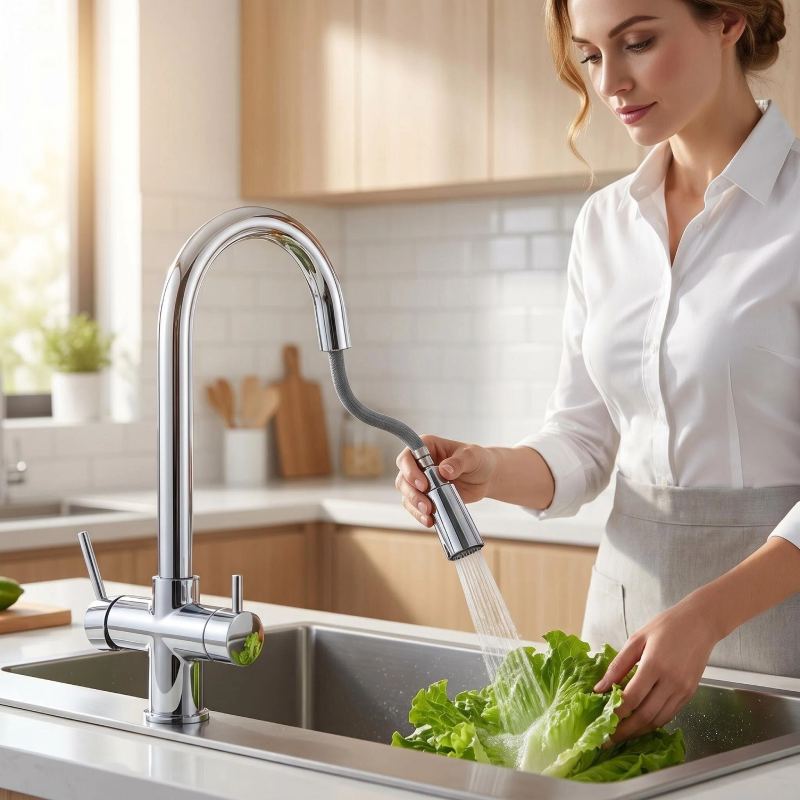
- Pull-out design: The spray head can be extended to make it easier to rinse the sink, vegetables, cookware, and larger items.
- No separate drinking water faucet required: This can eliminate the need for an additional small faucet beside the main kitchen faucet.
- Cleaner countertop appearance: A single integrated faucet creates a more streamlined kitchen sink area.
Pros
- Ideal for households that already own a filtration system
- Allows users to keep their existing filter rather than replacing it
- Combines three water functions into one faucet
- Maintains full kitchen faucet functionality
- Keeps filtered drinking water on a separate water pathway
- Pull-out functionality improves everyday washing and cleaning
Things to Consider
- The filtration system is sold separately. The faucet itself does not filter water.
- Check the filtered-water connection before ordering. Outlet tubing sizes vary among filtration systems.
- Plumbing connections differ by country. Standards in the United States, Europe, Australia, and other markets may require different adapters.
- Check RO system output pressure. Reverse osmosis systems may operate at relatively low outlet pressure, so compatibility should be confirmed.
Summary
If you already have an under-sink filter or reverse osmosis system and want to eliminate the separate drinking water faucet from your countertop, a 3-way pull-out kitchen faucet can be a practical integrated solution.
It allows you to continue using your existing filtration equipment while creating a cleaner and more functional kitchen sink area.
2. American Standard Saybrook — Best for Buyers Who Want a Complete Filtration Solution
Best for: Homeowners who do not currently have a filtration system and prefer to purchase a complete matched solution.
Unlike filter-ready 3-way faucets, this type of product is designed around a faucet and filtration system used together.
American Standard's Saybrook range provides a coordinated kitchen filtration solution, making it a convenient option for buyers who do not want to separately research faucet and filter compatibility.
Pros
- Matched filtration system: The faucet and filtration components are designed to work together.
- Simple operation: Filtered water can be controlled independently.
- Pull-down kitchen functionality: The faucet still provides the versatility expected from a modern kitchen faucet.
- Established brand: American Standard is a long-standing plumbing fixture brand.
- Suitable for first-time filtration buyers: Less time is required to research compatibility between separate components.
Things to Consider
- Replacement cartridges will be required.
- Long-term filter costs should be considered.
- Less flexible for households that already own a preferred filtration system.
3. Kraus Oletto 2-in-1 Filter Faucet — A Premium Choice for Modern Kitchens
Best for: Homeowners who place a strong emphasis on contemporary design and integrated filtration.
The Kraus Oletto range features a clean, modern appearance. Its 2-in-1 filter faucet design uses separate water supply routes for regular and filtered water and can be connected to an under-sink filtration system.
Pros
- Modern appearance: A streamlined design suited to contemporary kitchens.
- Convenient pull-down operation: The spray head can be extended for everyday cleaning.
- Dedicated filtered-water connection: Filtered water enters through a separate inlet.
- Suitable for under-sink filters and compatible RO systems.
Things to Consider
- The filtration system is generally sold separately.
- The overall price is higher than that of many conventional kitchen faucets.
4. Kraus Bolden 2-in-1 Filter Faucet — Best for Commercial-Style Kitchens
Best for: Homeowners who prefer industrial styling, commercial-inspired kitchen design, and a large pull-down faucet.
The Kraus Bolden has a very different visual style from the Oletto.
Its high-arc spout and exposed spring-style pull-down hose resemble the faucets commonly associated with professional or commercial kitchens. This makes it especially suitable for industrial and loft-inspired interiors.
Pros
- Distinctive appearance: The high-arc spring design creates a strong commercial-style look.
- Large spray range: The flexible hose gives the spray head greater reach.
- Regular and filtered water from one faucet: The 2-in-1 design allows both water types to be supplied through one fixture.
Things to Consider
- The faucet is relatively large. Make sure there is enough vertical clearance, particularly if there are cabinets above the sink.
- Compact kitchens may have space limitations.
- A separate filtration system is generally required.
5. Faucet-Mounted Water Filter — Best for Renters and Budget-Conscious Buyers
This option is not directly comparable with the full kitchen faucets above because it is not a replacement faucet.
Instead, it is a filtration attachment installed on the outlet of an existing faucet.
However, it can be a useful alternative for certain users.
Best for:
- Renters who are not allowed to modify plumbing
- People who do not want to change under-sink pipework
- Budget-conscious households
- Temporary living situations
- Users who do not want to replace their existing kitchen faucet
Pros
- Lower upfront cost
- Simple installation
- Easy to remove when moving or no longer needed
Things to Consider
- Filter replacement frequency: Smaller cartridges generally require more frequent replacement.
- Flow rate: Filtered-water flow may be noticeably slower.
- Filtration capability: These systems may be more limited than larger under-sink or RO systems.
- Certification: Check relevant filtration certifications and contaminant-reduction claims.
- Faucet compatibility: The attachment may interfere with pull-out or spray functions.
How to Choose the Best Kitchen Faucet With a Water Filter
Choosing the right faucet involves more than comparing brands and finishes.
Work through the following seven factors before making a purchase.
1. Start With Your Water Filtration Needs
Do not begin by choosing a faucet.
First determine:
What do you actually want to improve about your water?
Common concerns include:
- Taste and odor
- Chlorine
- Specific contaminants
- Dissolved solids
- Overall drinking water quality
Different filtration technologies address different needs.
Activated Carbon Filtration
Activated carbon is commonly used to improve taste and odor and reduce chlorine and certain organic compounds.
It generally does not significantly reduce total dissolved solids.
Ultrafiltration
Ultrafiltration can remove very small particles and certain microorganisms while typically allowing many dissolved minerals to remain in the water.
Reverse Osmosis
RO systems provide a much finer level of filtration and can reduce a wide range of dissolved substances.
However, they may require additional components such as a storage tank or booster pump, depending on the system.
More filtration stages do not automatically mean better water. The filtration technology should match your actual water quality and treatment goals.
2. Determine Whether the Faucet Includes the Filter
This is one of the easiest details to misunderstand.
Use your current setup to guide your decision:
| Your Current Situation | Recommended Option | Why |
|---|---|---|
| You already have an under-sink filter | 2-in-1 or 3-way filter-ready kitchen faucet | No need to purchase another filtration system |
| You already have an RO system | Kitchen faucet with a dedicated filtered-water inlet suitable for RO connection | RO water requires its own water pathway |
| You do not currently have a filtration system | Faucet and filtration package | Components are designed to work together |
| You rent your home | Faucet-mounted filter | Minimal modification and easy to remove |
3. Look for a Dedicated Filtered-Water Pathway
This is one of the most important structural features of a filtered kitchen faucet.
Ideally, filtered drinking water should have a separate:
- Water inlet
- Internal waterway
- Control mechanism
This helps keep filtered water separate from ordinary hot and cold tap water.
A 3-way kitchen faucet is especially useful in this regard because hot, cold, and filtered water can each have a dedicated supply route and control.
4. Check Compatibility With Your Under-Sink or RO System
Before purchasing, check the following:
- Filter outlet tubing size: Common sizes include 1/4 inch and 3/8 inch.
- Filtered-water inlet size on the faucet: Make sure it matches the filtration system.
- Adapter requirements: If the sizes differ, determine whether a suitable adapter is available.
- Filtration system output pressure
- Available cabinet space
- Filter location and accessibility
- Distance between the filter and faucet
Important: “RO compatible” does not necessarily mean every RO system will connect without modification. Different systems may use different tubing sizes, pressure ranges, and fittings.
5. Choose Between a Pull-Out and Fixed Spout
A Pull-Out or Pull-Down Faucet Is Better for:
- Rinsing fruit and vegetables
- Cleaning the sink basin
- Washing large pots, trays, and cookware
- Reaching sink corners
- Filling large containers
A Fixed Faucet May Be Better for:
- Basic use
- Smaller budgets
- Smaller sinks
- Users who do not need extended cleaning reach
If you want both filtration integration and full everyday kitchen functionality, a 3-way pull-out faucet offers a useful balance.
6. Check Faucet Materials and Cartridge Quality
Do not choose a faucet based on appearance alone.
Consider:
- Stainless steel
- Quality brass construction
- Low-lead or lead-free materials where applicable
- Ceramic cartridge
- Corrosion-resistant surface finish
- Availability of replacement parts
- Warranty terms
The internal construction and valve quality often matter more in the long term than the faucet's color or finish.
7. Consider Long-Term Filter Replacement Costs
If your faucet is supplied with a filtration system, the filter is an ongoing expense.
Check:
- Replacement cartridge price
- Replacement interval
- Rated filtration capacity
- Availability
- Whether proprietary filters are required
Over the long term, replacement cartridges may matter more financially than the initial purchase price of the faucet.
3-Way Kitchen Faucet vs. Separate Drinking Water Faucet
Many homeowners face this choice when installing an under-sink filtration system.
The comparison below highlights the main differences.
| Feature | 3-Way Kitchen Faucet | Main Faucet + Separate Drinking Water Faucet |
|---|---|---|
| Number of Faucets | One | Two |
| Countertop Holes | Usually one | Usually requires an additional hole |
| Hot and Cold Water | Yes | Provided by the main faucet |
| Filtered Water | Dedicated filtered-water pathway in the same faucet | Supplied through a separate faucet |
| Pull-Out Function | Available on selected models | Depends on the main faucet |
| Countertop Appearance | Cleaner and more integrated | More fixtures on the countertop |
| Installation | Multiple water lines connect to one faucet | Separate drinking faucet must also be installed |
| Cost | Higher price for one integrated faucet | Combined price may sometimes be lower |
| Flexibility | Entire faucet must be replaced when upgrading | Main and drinking faucets can be replaced separately |
A 3-Way Kitchen Faucet May Be Better If:
- You want a cleaner countertop.
- You already use an under-sink filter or RO system.
- You do not want a second drinking water faucet.
- You want pull-out kitchen functionality.
- You are remodeling and can plan the plumbing and faucet layout together.
A Separate Drinking Water Faucet May Be Better If:
- Your countertop already has an unused mounting hole.
- You do not want to replace your existing main kitchen faucet.
- You prefer a completely separate drinking water outlet.
- Your existing filtration system and drinking faucet already work well.
Neither solution is universally better.
If you are renovating your kitchen, a 3-way faucet may provide a cleaner and more integrated appearance.
If your kitchen is already finished and you want to avoid replacing the main faucet, a separate drinking water faucet may be the more practical choice.
Can a 3-Way Kitchen Faucet Work With a Reverse Osmosis System?
Yes, provided certain conditions are met.
The faucet must have a dedicated filtered-water inlet, and the connection must be compatible with the reverse osmosis system.
Basic Connection Layout
Filtered Water
Cold Water Supply → Reverse Osmosis System → Filtered-Water Line → Dedicated Filtered-Water Inlet on the 3-Way Faucet
Regular Kitchen Water
- The hot water supply connects directly to the faucet's hot-water inlet.
- The cold water supply connects directly to the faucet's cold-water inlet.
- Filtered water enters through a separate connection and remains independent from the regular hot and cold water lines.
Key Questions
Can a 3-way faucet work with an RO system?
Yes, as long as it has a dedicated filtered-water inlet and the connections are compatible.
Do I still need a separate small drinking water faucet?
No. A properly designed 3-way faucet already includes a filtered-water outlet.
Does filtered water enter the faucet separately?
Yes. It uses its own inlet and internal waterway.
Will I need an adapter?
Possibly. This depends on the size of the RO outlet tubing and the faucet connection.
Why is it important to check the fittings before buying?
Because different RO systems may use different tubing sizes and fittings. An incompatible connection can lead to poor flow or leaks.
Installation: What Should You Check Before Buying?
Sink and Countertop Holes
Confirm:
- Number of existing holes
- Hole diameter
- Countertop thickness
- Faucet base dimensions
If your countertop is unusually thick, the faucet mounting hardware may also need to be checked.
Under-Sink Cabinet Space
If you plan to install any of the following, measure the cabinet first:
- RO storage tank
- Water filter cartridges
- Multi-stage filtration system
- Filter brackets and housings
There should also be enough working space to connect tubing and replace filters.
Hose and Connection Sizes
This is particularly important when purchasing internationally.
Common plumbing connections can differ between the United States, Canada, the United Kingdom, Australia, and European markets.
Check:
- Water supply connection
- Filter outlet tubing size
- Filtered-water inlet on the faucet
- Whether adapters are required
Filtration System Location
Make sure:
- Filters are accessible for replacement.
- Tubing can be routed without excessive bending.
- Hoses are not pinched.
- Shut-off valves and fittings remain accessible for maintenance.
DIY Installation or Professional Plumber?
Users with basic plumbing experience may be comfortable replacing a faucet or making a simple filter connection.
Professional installation may be preferable when:
- Installing a complex reverse osmosis system
- Working with older plumbing
- Connection sizes do not match
- A new countertop hole must be drilled
- There is a higher risk of water damage if something leaks
Are Kitchen Faucets With Water Filters Worth It?
The answer depends on your household.
They Are Usually Worth Considering If:
- You drink filtered water every day.
- You already have an under-sink filtration system.
- You already use a reverse osmosis system.
- You dislike having a separate drinking water faucet on the countertop.
- You want a cleaner, more integrated kitchen design.
- You are renovating or remodeling your kitchen.
- You also use filtered water for cooking, making soup, or preparing food.
You May Not Need One Yet If:
- You rent your home.
- You rarely drink filtered water.
- Your existing separate drinking water faucet works well.
- You do not want to modify your kitchen plumbing.
- You only need a temporary filtration solution.
Which Type of Filtered Kitchen Faucet Should You Choose?
| User Type | Recommended Solution | Why |
|---|---|---|
| Already have an RO system | RO-compatible 3-way kitchen faucet | Dedicated filtered-water inlet allows RO water to be integrated into the main faucet |
| Already have an under-sink filter | 2-in-1 or 3-way filtered-water faucet | Keeps the existing filtration system while eliminating a separate drinking faucet |
| Prioritize everyday kitchen functionality | 3-way pull-out kitchen faucet | Combines pull-out convenience with separate filtered-water delivery |
| Do not currently have a filtration system | Faucet and filtration package | Easier compatibility and a more complete starting solution |
| Rent your home | Faucet-mounted filter | Low-cost, removable, and minimal installation |
| Prefer a minimalist kitchen | Single-hole 3-way faucet | One fixture provides multiple water functions while keeping the countertop clean |
Final Verdict
The best kitchen faucet with a water filter depends first on your filtration setup—not simply on the faucet brand.
- If you already have an under-sink filter or reverse osmosis system, a 2-in-1 or 3-way filter-ready kitchen faucet usually gives you greater flexibility. You can keep your existing filtration system and simply replace the faucet with one that incorporates a filtered-water outlet.
- If you do not currently have a filtration system, choosing a faucet and filter package may be easier because the components are designed to work together.
- If you want hot water, cold water, filtered drinking water, pull-out functionality, and a cleaner countertop, a 3-way pull-out kitchen faucet is one of the most practical options to consider.
Before making your final decision, check connection sizes, cabinet space, filtration requirements, and long-term filter costs.
These details often have a greater impact on everyday usability than the brand name alone.
If you want to explore different styles and connection options, you can also browse the Liliumfaucet 3-Way Kitchen Faucet Collection, which includes multiple finishes and designs for different kitchen styles.
Frequently Asked Questions
What Is the Best Kitchen Faucet With a Water Filter?
There is no single best option for every household.
Your decision should depend on:
- Whether you already have a filtration system
- Whether you use reverse osmosis
- Whether you want a pull-out faucet
- Whether you want the filtration system included
- Your budget
- Your kitchen layout and style
The best faucet is the one that fits your existing plumbing and everyday needs, rather than simply the most expensive model.
Does a Kitchen Faucet With Filtered Water Always Include a Filter?
No.
Some products include a filtration system and are sold as a complete package.
Many 2-in-1 and 3-way kitchen faucets, however, do not filter water themselves. They are designed to connect to an external under-sink filtration or RO system.
Always check whether the product includes an actual filtration system or simply provides a dedicated filtered-water connection.
Can a 3-Way Kitchen Faucet Connect to a Reverse Osmosis System?
Yes.
The main requirements are:
- A dedicated filtered-water inlet
- A compatible connection between the faucet and RO outlet tubing
- Suitable plumbing configuration
An adapter may be required if the tubing and faucet connections use different sizes.
Does an Under-Sink Water Filter Require a Separate Faucet?
Not necessarily.
A 2-in-1 or 3-way kitchen faucet can integrate filtered drinking water into the main kitchen faucet through a dedicated water pathway.
This eliminates the need for a separate small drinking water faucet.
What Is the Difference Between a 3-Way Kitchen Faucet and a Regular Kitchen Faucet?
A regular kitchen faucet normally provides:
- Hot water
- Cold water
A 3-way kitchen faucet adds a separate filtered drinking water supply.
The filtered water is typically controlled independently and travels through a dedicated water pathway.
Is a 3-Way Faucet Better Than a Separate Drinking Water Faucet?
It depends on your kitchen and preferences.
A 3-way faucet provides:
- A cleaner countertop
- Multiple water functions from one fixture
- A more integrated appearance
A separate drinking water faucet provides:
- A completely separate fixture
- The ability to keep your existing main faucet
- Greater flexibility when replacing individual components
Neither option is universally better.
Can Tap Water and Filtered Water Come From the Same Faucet?
Yes.
However, choose a faucet specifically designed with a dedicated filtered-water pathway.
A properly designed 2-in-1 or 3-way faucet keeps filtered water separate from regular tap water inside the faucet.
Is a Faucet-Mounted Filter Better Than an Under-Sink Filter?
It depends on your needs.
Faucet-mounted filters are:
- Affordable
- Easy to install
- Suitable for renters
- Convenient for temporary use
However, their filtration capacity and flow rate may be more limited.
Under-sink filtration systems offer:
- More filtration technology options
- Higher filtration capacity
- A cleaner faucet appearance
- Better suitability for long-term household use
For homeowners who plan to stay in the same property and have higher filtration requirements, an under-sink system is often the more practical long-term solution.
Can a Pull-Out Kitchen Faucet Connect to an RO System?
Yes.
The pull-out feature itself does not determine RO compatibility.
What matters is whether the faucet has:
- A dedicated filtered-water inlet
- A separate internal filtered-water pathway
If those features are present and the plumbing connections are compatible, both fixed and pull-out kitchen faucets can be used with a reverse osmosis system.
.jpeg?w=800&h=800)