
In many households, people rely on bottled sparkling water to meet their daily drinking needs. However, this method comes with several problems. Bottled water not only needs to be carried frequently, but also requires dedicated storage space. You also need to keep track of the remaining supply so that you can restock it in time. Although countertop sparkling water makers have a relatively low initial cost, they can be inconvenient to use. You need to fill them with water manually each time and repeat the carbonation process to produce enough sparkling water.
This is where an under-sink sparkling water system stands out. It can provide chilled sparkling water directly from the kitchen faucet, bringing great convenience to the household. However, products on the market vary greatly in price, functions, installation methods, and water output capacity.
This article will compare different types of sparkling water taps and representative products in detail. It will also provide a complete buying checklist to help you choose the most suitable sparkling water tap for your home.
What Is a Sparkling Water Tap for Home Use?
A sparkling water tap does not produce sparkling water through the faucet alone. A complete home sparkling water system usually consists of a faucet, chilling unit, carbonation unit, filter, CO₂ cylinder, pressure regulator, connecting tubes, and other components.
Tap water first flows into the under-sink unit, where it is filtered to reduce some impurities and improve the taste of the water. It is then chilled, as a lower water temperature helps CO₂ dissolve more effectively. Food-grade CO₂ then passes through the pressure regulator and enters the carbonation unit, where it mixes with the chilled water to create bubbles. Finally, the sparkling water flows out through the faucet.
It is important to distinguish between a “sparkling water tap only” and a “complete sparkling water system.” Purchasing only a sparkling water tap usually will not allow you to produce sparkling water because the essential carbonation equipment is not included. In addition, some products require users to purchase a food-grade CO₂ cylinder locally. Therefore, before buying, make sure you understand whether the product is a complete sparkling water system.
How Does a Sparkling Water Tap for Home Use Work?
Step 1 — Water Enters the Filtration System
The filter plays an important role in the system. It is mainly used to improve the taste of the water and reduce specific impurities, such as chlorine, unpleasant odors, and sediment. However, not every filter can remove every contaminant. Users should choose a suitable product based on local water quality and the certifications obtained by the filter.
The filter may also affect the incoming water flow. Therefore, check the minimum flow-rate requirement of the equipment to make sure the filter does not restrict the water excessively and prevent the system from operating normally.
Step 2 — The Water Is Chilled
A lower water temperature helps CO₂ dissolve more effectively, so the chilling system is a key component that affects the taste and stability of the sparkling water. Common chilling methods include chilled water tanks and continuous chilling systems. A chilled water tank cools and stores water in advance, while a continuous chilling system cools the water in real time.
When choosing a system, check the amount of water that can be dispensed at one time and the recovery time of the chilling system to make sure it can meet your household’s needs in different situations.
Step 3 — CO₂ Is Injected into the Chilled Water
Food-grade CO₂ enters the carbonation unit through a pressure regulator and mixes with the chilled water to create bubbles. However, the CO₂ pressure must be set strictly according to the manufacturer’s requirements. Higher pressure is not always better. Incorrect pressure may cause splashing, unstable carbonation, or even trigger the equipment’s protection system.
Step 4 — Sparkling Water Flows Through a Dedicated Waterway
Sparkling water should preferably flow through a separate internal waterway. This helps prevent it from mixing with regular hot and cold water and maintains the quality of the sparkling water.
A dedicated sparkling water tap is only responsible for dispensing sparkling water, while a multifunctional faucet can combine several types of water. Although a multifunctional faucet is more convenient, users should understand how to switch between and operate its different functions.
.webp?w=1000&h=1000)
What Are the Main Types of Sparkling Water Taps for Home Use?
Dedicated Sparkling Water Tap
A dedicated sparkling water tap only provides sparkling water, chilled water, or filtered water. It usually requires an additional hole in the sink or countertop.
This type is suitable for households that want to keep their existing kitchen faucet, as the initial modifications are relatively limited. However, it may affect the overall clean and simple appearance of the countertop.
3-Way Sparkling Water Tap
A common 3-way sparkling water tap combination includes filtered water, chilled water, and sparkling water. One faucet is used to manage all drinking water functions.
However, regular kitchen hot and cold water may still require a separate main kitchen faucet. When purchasing, do not judge the product’s functions based only on the term “3-way.” You must confirm the three specific types of water it provides to avoid purchasing a product that does not meet your needs.
5-Way Multifunctional Kitchen Faucet
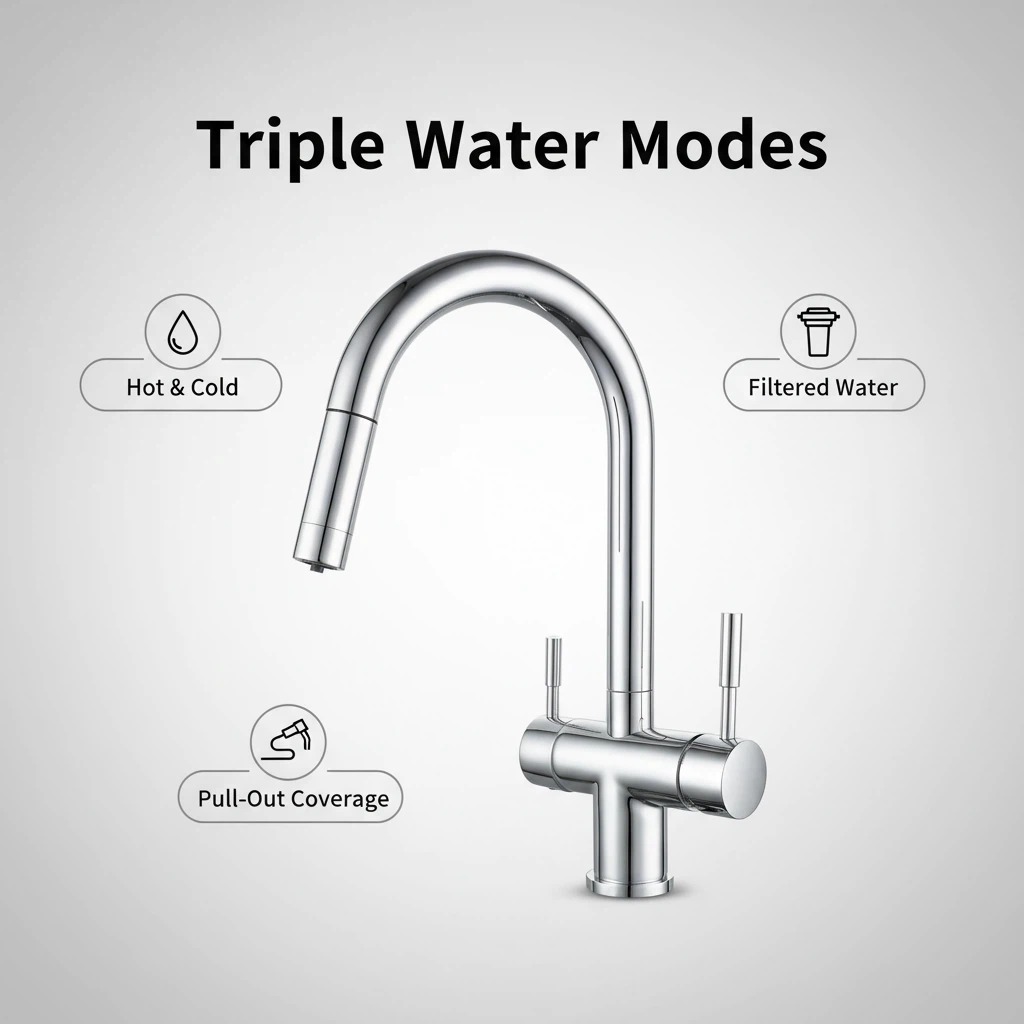
A 5-way multifunctional kitchen faucet can combine regular hot water, regular cold water, filtered water, chilled water, and sparkling water in one faucet.
This type is suitable for households renovating their kitchens or those that want to reduce the number of holes in the countertop. However, the under-sink connections are relatively complicated. Before purchasing, make sure each type of water has separate controls and an independent internal waterway to ensure convenient use and safe water quality.
For example, the Liliumfaucet 5-way solution combines several functions in one faucet, making it suitable for households that want to avoid installing an additional drinking water tap.
All-in-One Boiling, Chilled, and Sparkling Water System
This type of system provides boiling water, chilled water, and sparkling water. It is suitable for high-budget luxury kitchens.
However, these systems are usually larger, require more power, and have stricter installation and maintenance requirements. During use, special attention should be paid to child safety, proper boiling water control, and compliance with installation requirements.
Countertop Sparkling Water Maker
A countertop sparkling water maker is not a true sparkling water tap. It has a lower initial cost and does not require any changes to the kitchen plumbing.
However, users need to fill it with water manually, chill the bottles, and repeat the process during use. It is more suitable for people who drink sparkling water infrequently or for renters.
Recommended Sparkling Water Taps for Home Use
GROHE Blue Chilled & Sparkling — Suitable for Premium Households That Value Smart Features
GROHE Blue Chilled & Sparkling is positioned as a premium smart under-sink sparkling water system. It can provide filtered, chilled, and sparkling water. Its connected features allow users to monitor usage, filter status, and CO₂ status, making it suitable for people who value brand reputation, design, and smart management.
However, buyers should note that some filters, CO₂ cylinders, and cleaning accessories may need to be purchased separately. The equipment and installation costs are relatively high. When comparing prices, you should not focus only on the faucet price. You should calculate the price of the complete system.
For example, the official GROHE product page shows that the system provides chilled and sparkling water and supports connected functions. Some faucet packages in the US market are relatively expensive, and the filter, CO₂ cylinder, and certain accessories may need to be purchased separately.
Zip HydroTap — Suitable for an All-in-One Kitchen That Needs Boiling, Chilled, and Sparkling Water
Zip HydroTap is positioned as a premium multifunctional drinking water system. It can provide filtered boiling water, chilled water, and sparkling water. It is suitable for households with frequent cooking, tea-making, and daily drinking water needs.
It emphasizes the convenience of integrating several types of water into one faucet, providing users with a more convenient experience.
However, the system has a high purchase cost and requires professional installation. The voltage, capacity, and water output may vary between configurations. Current prices and the specifications of different models should be checked again before publication.
For example, Zip officially positions HydroTap as an all-in-one boiling, chilled, and sparkling water system for homes. Some configurations in the US market have a relatively high starting price, making them more suitable for high-budget kitchen projects.
Quooker with CUBE — Suitable for Households Already Considering a Boiling Water Tap
Quooker is mainly based on an instant boiling water system. After adding the CUBE module, it can also provide filtered chilled water and sparkling water.
This combination is suitable for users who already plan to purchase a boiling water tap and also want to add sparkling water. It demonstrates the advantage of modular expansion.
However, it should be made clear that the complete system involves more than purchasing a single faucet. Users need to confirm the compatibility between the faucet, tank, and CUBE.
For example, Quooker states that its system can provide 100°C boiling water and can add filtered chilled and sparkling water through the CUBE.
Liliumfaucet Under-Sink Sparkling Water System — Suitable for Households That Value Cost-Effectiveness and Faucet Options
The Liliumfaucet under-sink sparkling water dispenser is positioned as a relatively flexible under-sink sparkling water solution. Users can choose a 3-way or 5-way faucet.
The 3-way option is suitable for providing sparkling water, chilled water, and filtered water from one faucet. The 5-way option can also integrate regular hot and cold water, making it suitable for users who do not want to add another countertop hole for drinking water. The multifunctional faucet can be presented as a key point of difference.
It should be clearly explained whether the CO₂ cylinder needs to be purchased locally. The equipment, voltage, connections, and installation requirements should also be introduced.
Real customer videos or installation examples can be used to improve credibility, while the suitable applications and limitations should also be listed.
The current Liliumfaucet under-sink system page states that the sparkling water output is approximately 6–8 liters per hour, while the amount of chilled water available in one continuous dispensing cycle is approximately 600–700 milliliters. Both 3-way and 5-way faucet configurations are available.
How to Choose a Sparkling Water Tap for Your Home
First Decide Which Water Functions You Need
Users can choose from the following functions:
- Regular cold water
- Regular hot water
- Filtered room-temperature water
- Filtered chilled water
- Sparkling water
- Instant boiling water
The following selection guidelines may help:
- If you only need sparkling water: choose a dedicated sparkling water tap.
- If you need filtered water, chilled water, and sparkling water: choose a 3-way system.
- If you want to keep full kitchen hot and cold water functions: choose a 5-way faucet.
- If you also need boiling water for tea and cooking: choose an all-in-one boiling, chilled, and sparkling water system.
Compare Sparkling Water Output, Not Only Tank Capacity
When choosing a sparkling water tap, do not focus only on the tank capacity. You should also check the sparkling water output per hour, the amount that can be dispensed continuously at one time, the chilling recovery time, and how long you need to wait after periods of high use.
You should distinguish between normal daily household use and concentrated demand during parties. A large tank does not necessarily mean a higher continuous sparkling water output.
Suggested household consumption categories are as follows:
- Low consumption: 1–2 liters per day
- Medium consumption: 2–2.5 liters per day
- High consumption: more than 5 liters per day
- Parties or home bars: require higher immediate and continuous dispensing capacity
Check Whether the Carbonation Level Can Be Adjusted
Some systems allow users to adjust the carbonation level through equipment settings or CO₂ pressure. However, users should not exceed the pressure specified by the manufacturer.
Water temperature, CO₂ pressure, dispensing speed, and water quality can all affect the carbonation experience. Users who prefer strong carbonation should prioritize real product demonstrations and customer feedback. Product comparisons should also explain whether the system produces fine, gentle bubbles or stronger carbonation.
Confirm the CO₂ Cylinder Specifications and Local Supply
Confirm whether the equipment includes a CO₂ cylinder and whether food-grade CO₂ is required. Check the cylinder size and connection type, and find out whether it can be refilled or exchanged locally.
Compare the long-term costs of small proprietary cylinders and larger refillable cylinders. Confirm whether the pressure regulator is included and whether the cylinder can be stored safely inside the cabinet.
Check Whether the Filtration System Is Suitable for Local Water Quality
Understand the main functions and certifications of the filter. Different filter cartridges may target chlorine, unpleasant odors, sediment, hardness, or specific contaminants.
Hard-water areas may require additional treatment. Excessive filtration may reduce the incoming water flow.
Before using an RO system, confirm compatibility with the equipment manufacturer. Avoid unsupported statements such as “filtered water is always healthier.”
Measure the Available Space Under the Sink
Measure the following before installation:
- Cabinet width
- Cabinet depth
- Cabinet height
- Space occupied by the drainpipe
- Space occupied by the garbage disposal
- Space required for the filter
- Space required for the CO₂ cylinder
- Ventilation space around the equipment
- Working space required for future filter and cylinder replacement
It is recommended to include an under-sink installation dimensions diagram in the article.
Confirm the Power Supply, Voltage, Water Pressure, and Inlet Flow Rate
Most chilled sparkling water systems require electricity. Confirm whether the system is available in a 110V, 220V, or 240V version. Plugs and voltages vary between countries.
Check the minimum and maximum incoming water pressure required by the equipment. Measure the actual water flow after the filter. Insufficient incoming water may affect refilling and continuous dispensing.
Do not only measure the unfiltered tap water pressure. Carefully review the manufacturer’s instructions before installation.
Choose a Multifunctional Faucet with Separate Waterways
Regular hot and cold water and filtered drinking water should preferably use separate internal waterways. Separate waterways help prevent drinking water from coming into contact with regular mixed water.
Confirm that the cartridge and internal waterway materials are suitable for drinking water. Check whether the faucet has clear function markings and avoid control designs that are easy to operate incorrectly.
For a 5-way faucet, the control method should be explained clearly.
Consider Noise and Ventilation
The compressor, chilling system, and pump may produce sound during operation. The sound is usually reduced when the cabinet door is closed.
The equipment needs sufficient airflow and should not be completely sealed inside a small cabinet. Noise is an important purchasing factor for users with open-plan kitchens.
It is recommended to watch a real operating video instead of relying only on product images.
Compare Warranty and After-Sales Service
Compare the following warranty and after-sales service information:
- Warranty period
- Whether the compressor, pump, and electronic components are covered
- Whether the faucet and equipment are covered by the same warranty
- Whether installation guidance is provided
- Whether remote diagnosis is available
- Whether local service personnel are available
- Whether faulty components are repaired or replaced
- Who pays the return shipping cost
What Should Be Prepared Before Installing a Sparkling Water Tap?
Plumbing Requirements
- Cold-water inlet
- Suitable tee valve or adapter
- Sufficient incoming water pressure and flow
- Pipe size that matches the equipment
- Confirmation that commonly used connections may differ between the United States, Canada, the United Kingdom, Australia, and Europe
Electrical Requirements
- A suitable electrical outlet near the under-sink area
- Avoid using extension cords that do not meet the requirements
- Confirm that the outlet complies with local kitchen electrical regulations
- High-powered all-in-one boiling water systems may have additional electrical requirements
CO₂ Equipment
- Food-grade CO₂ cylinder
- Compatible pressure regulator
- Correct CO₂ tube size
- Cylinder securing device
- A local supplier that can refill or exchange the cylinder
Faucet Installation Hole
- Confirm the size of the existing sink hole
- Confirm the faucet installation hole requirements
- A dedicated sparkling water tap may require an additional hole
- A multifunctional faucet can usually replace the existing main faucet
- Professional drilling is recommended for quartz or natural stone countertops
Is Professional Installation Required?
Users with good basic plumbing skills may be able to install some systems themselves. However, professional installation is recommended when boiling water, electrical modifications, or complicated plumbing connections are involved.
Incorrect connections may cause leaks, low water flow, or equipment protection errors. The warranty terms may also include requirements regarding the installation method.
How Much Does It Cost to Install a Sparkling Water Tap for Home Use?
Equipment Purchase Cost
- Faucet
- Chilling and carbonation unit
- Filter
- CO₂ pressure regulator
- Connecting tubes and adapters
- CO₂ cylinder
Installation Cost
Factors that affect the installation cost include:
- Whether the main kitchen faucet needs to be replaced
- Whether a new countertop hole is required
- Whether a new electrical outlet is required
- Whether the cabinet needs to be modified
- Local plumber fees
- Whether official installation from the brand is included
Long-Term Operating Costs
- CO₂ refill costs
- Filter replacement costs
- Electricity costs
- Cleaning and sanitizing supplies
- Regular maintenance costs
- Replacement parts
Suggested Annual Cost Calculation
Annual total cost = Equipment depreciation cost + CO₂ cost + Filter cost + Electricity cost + Maintenance cost
Note: Prices vary depending on the country, model, and time. Check official prices again before publication. Do not treat the price of the faucet alone as the price of the complete system.
Which Is Better: A Sparkling Water Tap, SodaStream, or Bottled Sparkling Water?
| Comparison Item | Sparkling Water Tap | Countertop Sparkling Water Maker | Bottled Sparkling Water |
| Initial Cost | High | Low | Low |
| Long-Term Cost | Relatively high, including CO₂, filters, electricity, and other costs | Relatively low, mainly CO₂ costs | High because it requires continuous purchasing |
| Convenience | High, available directly from the tap | Lower, requires manual operation | Moderate, ready to drink after opening but requires carrying and storage |
| Manual Water Filling Required | No | Yes | No |
| Automatic Chilling | Some systems | No | No |
| Carbonation Level | Adjustable on some systems | Adjustable on some machines | Relatively fixed |
| Amount Available at One Time | Dispensed as needed | Limited by machine or bottle capacity | Limited by bottle capacity |
| Countertop Space | Not required for under-sink systems | Required | Not required |
| Under-Sink Space | Required | Not required | Not required |
| CO₂ |
When a Sparkling Water Tap Is a Suitable Choice
A sparkling water tap may be suitable in the following situations:
- You drink large amounts of sparkling water every day, and a sparkling water tap can meet frequent daily drinking needs at any time.
- You want sparkling water available directly from the tap without the manual operation required by a countertop sparkling water maker, saving time and effort.
- You do not want to place a machine on the countertop. An under-sink sparkling water tap system can help keep the countertop tidy.
- You are renovating or remodeling your kitchen and can include the sparkling water tap in the overall kitchen plan for better functional integration.
- You want to combine filtered water and sparkling water in one system to meet your household’s drinking water needs.
- You can accept a higher initial investment in exchange for long-term convenience and a better drinking water experience.
When a Countertop Sparkling Water Maker Is a Suitable Choice
A countertop sparkling water maker may be suitable in the following situations:
- You drink sparkling water infrequently and do not need to make it often, so the manual operation is acceptable.
- You rent your home or cannot modify the plumbing. A countertop sparkling water maker does not require changes to the kitchen plumbing and can be moved easily.
- You have a limited budget, and its lower initial cost is more suitable for users with a smaller budget.
- You do not mind making sparkling water manually and can accept manually filling the bottle and operating the machine each time.
- You have enough countertop space for a countertop sparkling water maker.
When Continuing to Buy Bottled Sparkling Water May Be More Suitable
Continuing to buy bottled sparkling water may be more suitable in the following situations:
- You rarely drink sparkling water, so buying bottled sparkling water avoids purchasing equipment for occasional use.
- You prefer the mineral taste of a specific natural mineral water. Bottled sparkling water provides more choices of brands and flavors.
- You do not want to deal with equipment maintenance and do not want to consider the servicing or repair of a sparkling water tap or countertop sparkling water maker.
- You do not have suitable installation space, such as a small kitchen that cannot accommodate a sparkling water tap system.
How Should Different Households Choose?
Households with Fewer Than Two People
Give priority to a small under-sink system or countertop machine. Because there are fewer household members, there is no need to pursue very high output.
Pay attention to standby electricity consumption and under-sink space. Choose a more energy-efficient product that does not take up too much space while still meeting small but consistent daily sparkling water needs.
Households That Drink Large Amounts of Sparkling Water Every Day
Focus on comparing hourly output to make sure the system can meet frequent drinking needs.
Choose a larger CO₂ cylinder to reduce how often it needs to be replaced. Check the continuous dispensing capacity to avoid interruptions during periods of concentrated use.
At the same time, choose a system with filters and CO₂ cylinders that are easy to replace to reduce daily maintenance costs and time.
Households with Children
The control design should be clear and easy to understand for both children and adults.
If the system includes boiling water, a safety lock must be carefully considered to prevent children from touching it accidentally and being burned.
The CO₂ cylinder should be secured firmly to prevent it from falling and causing danger. Children should also not be allowed to adjust the pressure equipment by themselves.
Households Renovating Their Kitchens
Reserve power, installation space, and ventilation areas during the cabinet design stage.
A 3-way or 5-way integrated faucet can be given priority because it combines several functions, reduces the number of countertop holes, and improves the overall appearance of the kitchen.
Confirm the countertop hole and plumbing positions in advance to ensure smooth installation and better integration with the kitchen renovation.
Households with Completed Kitchens
Give priority to a dedicated faucet system that does not require major modifications.
Check whether a suitable electrical outlet is available to provide power to the equipment. Confirm whether the existing cabinet can accommodate the main unit and CO₂ cylinder to avoid installation problems caused by insufficient space.
Choose a solution that requires fewer changes to the existing kitchen facilities to reduce renovation costs and installation time.
Households That Frequently Make Cocktails
Pay attention to carbonation strength and consistency to meet the need for strong carbonation when making cocktails.
Choose a system with a lower dispensing temperature because colder water helps maintain the taste of cocktails.
Check the continuous dispensing capacity during periods of high demand to ensure that enough sparkling water can be provided when making several cocktails.
You may also consider installing a dedicated sparkling water tap in the home bar area for easier access and improved convenience.
How to Maintain a Sparkling Water Tap
Replacing the CO₂ Cylinder
Determine the replacement schedule based on usage. Consider replacing the cylinder when sparkling water output decreases noticeably or when the CO₂ cylinder pressure indicator is low.
Close the cylinder valve before removing it. Check the seal according to the instructions and make sure there are no leaks after the new cylinder is installed.
Using incompatible cylinders or connectors is not recommended because this may create safety risks.
Replacing the Filter
Replace the filter based on time, water consumption, or equipment reminders.
A new filter cartridge usually needs to be flushed after installation to remove residues left from the manufacturing process.
Failing to replace the filter for a long time may affect the taste and water flow and reduce the quality of the sparkling water.
Cleaning the Water Lines and Outlet
Clean or sanitize the system according to the manufacturer’s requirements. A dedicated cleaning solution or sanitizer may be used.
Clean the faucet outlet regularly to prevent scale and impurities from building up and affecting water flow.
After the system has not been used for a long time, flush the water lines before using it again to ensure the water is clean.
Checking Cabinet Ventilation and Water Leaks
Keep the ventilation areas around the equipment unobstructed to ensure proper heat dissipation.
Regularly inspect the connectors and tubing for signs of water leakage. Check whether the CO₂ tube is bent, as this may affect CO₂ delivery.
Do not place objects directly against the compressor ventilation area because this may affect heat dissipation and cause equipment problems.
Common Buying Mistakes
- Purchasing only the faucet without purchasing the carbonation unit, making it impossible to produce sparkling water.
- Assuming that all 3-way faucets have the same functions without confirming the specific types of water provided.
- Failing to confirm whether the CO₂ cylinder is included, which may result in additional costs and inconvenience later.
- Ignoring whether the CO₂ cylinder can be refilled locally, which may prevent the system from being used normally.
- Failing to measure the under-sink space and later discovering that the equipment cannot be installed.
- Installing the equipment inside a completely sealed cabinet, affecting heat dissipation and shortening the equipment’s service life.
- Failing to confirm the voltage, which may damage the equipment or prevent it from operating normally.
- Failing to confirm the water pressure and flow rate after filtration, affecting normal equipment operation.
- Focusing only on the equipment price without calculating installation and consumable costs, causing later expenses to exceed the budget.
- Assuming that every system can connect directly to an RO system without confirming compatibility with the manufacturer.
- Failing to confirm the amount of water available in one continuous dispensing cycle and the recovery time, making the system unable to meet actual needs.
- Purchasing based only on advertising descriptions such as “strong carbonation” without watching a real demonstration, resulting in carbonation that does not meet expectations.
- Failing to understand the return, warranty, and repair policies, making problems more difficult to resolve.
Pre-Purchase Checklist
- Approximately how much sparkling water do I need each day?
- Which water functions do I need?
- Do I want to keep my existing kitchen faucet?
- How much space is available under the sink?
- Is there an electrical outlet under the sink?
- Does the voltage match?
- Does the water flow rate after filtration meet the equipment requirements?
- Is the filter included?
- Is the CO₂ pressure regulator included?
- Is the CO₂ cylinder included?
- Can food-grade CO₂ be refilled locally?
- What is the sparkling water output per hour?
- How much chilled or sparkling water can be dispensed continuously at one time?
- Can the carbonation strength be adjusted?
- Is the operating noise acceptable?
- Is professional installation required?
- How often does the filter need to be replaced?
- Which parts are covered by the warranty?
- Is local after-sales support available?
- What is the total budget after complete installation?
Is a Sparkling Water Tap for Home Use Worth Buying?
A sparkling water tap is worth buying for some households, but it is not suitable for every household.
It may be worth buying in the following situations:
- You frequently drink sparkling water and can fully use the convenience of the tap to meet your drinking needs at any time.
- You value convenience and want to avoid manual operation or frequent purchases of bottled sparkling water.
- You do not want to keep buying bottled water and want to reduce the inconvenience of carrying, storing, and restocking it.
- You have suitable under-sink space to accommodate the sparkling water system.
- You can obtain food-grade CO₂ reliably to keep the system operating normally.
- You can accept a higher initial investment in exchange for long-term convenience and a better drinking water experience.
It may not be suitable in the following situations:
- You rarely drink sparkling water, so the system may have a low usage rate and become an unnecessary purchase.
- You rent your home and cannot modify the plumbing, making it impossible to install an under-sink sparkling water system.
- Your under-sink space is very limited and cannot accommodate the required equipment.
- You cannot refill or replace the CO₂ cylinder conveniently, which may prevent continuous use.
- You do not want to pay for filters and maintenance, as these costs continue after the initial purchase.
It should be emphasized that the greatest value of a sparkling water tap is usually not short-term savings. Its main value comes from instant dispensing, reduced manual operation, saved countertop space, and an improved daily drinking water experience.
Conclusion — Choosing the Right Sparkling Water System for Your Home
There is no single best product that is suitable for everyone.
Premium users may consider all-in-one solutions from GROHE, Zip, or Quooker. These products usually offer more complete functions and stronger brand services, but their prices and installation requirements are also relatively high.
Users who value cost-effectiveness and flexible faucet configurations can compare 3-way and 5-way under-sink systems to meet different household needs for functions and budget.
People who use sparkling water infrequently or live in rented homes can first choose a countertop sparkling water maker to meet occasional sparkling water needs at a lower cost.
Again, before purchasing, make sure to check the water functions, output capacity, under-sink space, CO₂ supply, installation requirements, and long-term costs.
It is recommended to contact the supplier to confirm the connections, voltage, incoming water conditions, and complete package contents to ensure that the product is suitable and can be installed and used correctly.
FAQ
FAQ 1: Can a Sparkling Water Tap Produce Sparkling Water Directly?
The faucet itself usually does not produce sparkling water. It needs to be connected to an under-sink chilling and carbonation unit.
A complete system may also include a filter, CO₂ cylinder, and pressure regulator. Before purchasing, confirm whether the product is only a faucet or a complete system.
FAQ 2: Does a Sparkling Water Tap for Home Use Require a CO₂ Cylinder?
Most under-sink sparkling water systems require food-grade CO₂.
The cylinder may not be included in the equipment package. You need to confirm the cylinder size, connection type, and local refill or exchange options.
FAQ 3: Does a Sparkling Water Tap Require Electricity?
Systems with chilling and automatic carbonation usually require electricity. A faucet by itself may not require power.
Before installation, confirm the voltage, plug type, and power requirements.
FAQ 4: Can a Sparkling Water Tap Be Connected to an RO System?
Some systems can be connected to an RO system, but you should not assume that all products are compatible.
The incoming water flow, pressure, water quality, and equipment requirements must be confirmed. Some systems may be more suitable for normally filtered water.
Check with the manufacturer before purchasing.
FAQ 5: Can the Carbonation Strength of a Sparkling Water Tap Be Adjusted?
Different products use different adjustment methods. Carbonation may be adjusted through equipment settings, CO₂ pressure, or flow control.
The manufacturer’s requirements must be followed. Water temperature and dispensing speed can also affect the taste.
FAQ 6: How Much Under-Sink Space Does a Sparkling Water Tap Require?
The required space depends on the dimensions of the main unit, filter, and CO₂ cylinder.
Additional space is also required for ventilation and replacing consumable parts. Ask for a complete dimensions diagram and measure the available space before purchasing.
FAQ 7: Is a Plumber Required to Install a Sparkling Water Tap?
Some simple systems may be installed by the user.
However, professional installation is recommended if the installation involves countertop drilling, electrical modifications, boiling water, or complicated plumbing.
Professional installation can help reduce water leaks and flow problems.
FAQ 8: Is a Sparkling Water Tap Better Than SodaStream?
A sparkling water tap is more convenient and is suitable for frequent use. SodaStream has a lower initial cost and does not require changes to the plumbing.
The choice should be based on drinking volume, budget, available space, and whether you rent or own your home.
FAQ 9: How Often Does the CO₂ Cylinder Need to Be Replaced?
The replacement frequency depends on the cylinder size, water consumption, and carbonation strength.
There is no fixed replacement schedule that applies to every system. Refer to the manufacturer’s output data and your actual usage records.
FAQ 10: Does a Sparkling Water Tap Need Regular Cleaning?
Yes. The filter needs to be replaced, the faucet outlet needs to be cleaned, and the water lines should be flushed as required.
Some systems have dedicated cleaning procedures or cleaning supplies. The specific cleaning schedule should follow the product instructions.
.jpeg?w=800&h=800)
.jpg?w=375&h=247)