When many people search for “best under sink water filter,” what they really want to know is not which product is absolutely the best, but which type of under-sink water filtration solution is most suitable for their household.
Different households have different water quality, drinking water needs, cabinet space, flow rate requirements, and budgets. Therefore, when choosing an under sink water filter, you need to consider several factors:
- Filtration method
- Contaminants you want to reduce
- Water flow rate
- Filter cartridge lifespan
- Installation space
- Long-term maintenance costs
- Whether you need reverse osmosis (RO)
- Whether you need to install an additional drinking water faucet
- Whether the system needs to connect to a 3-way kitchen faucet, sparkling water dispenser, or instant hot water appliance
Here is the conclusion first: There is no single under sink water filter that is suitable for every household. The right under sink water filtration system should be selected according to your household water quality and actual use case, rather than simply based on the number of filtration stages or price.
Best Under Sink Water Filters for 2026: Quick Recommendations
Different kitchen needs are better suited to different types of kitchen water filters. The following table can help you quickly identify which type of system may be suitable for you:
| Recommended Use Case | Water Filter Type | Main Advantage |
|---|---|---|
| High-flow use | High-flow single-stage under sink water filter | Fast water flow and compact design |
| Multi-layer filtration | 2-stage under sink water filtration system | Different filter media provide staged filtration |
| Deep filtration | RO reverse osmosis system | Can reduce more dissolved substances |
| Small kitchens | Compact direct-connect water filter | Saves cabinet space |
| Multi-functional kitchens | Water filter + multi-way kitchen faucet | Integrates drinking water and tap water |
The purpose of this section is not to immediately recommend one particular product, but to explain an often-overlooked fact: Different filtration systems solve different problems, and more filtration stages do not necessarily mean better water.
Which Type of Under Sink Water Filter Is Best for Different Kitchen Needs?
Best for High-Flow Daily Drinking Water: Liliumfaucet High-Flow Under-Sink Water Filter
If your household mainly needs filtered water for daily drinking, cooking, coffee, and tea, and you want fast water flow without taking up much cabinet space, the Liliumfaucet Home High-Flow Under-Sink Water Filter is worth considering.
Its key features include:
- Compact single-stage design that takes up very little space inside the cabinet
- Rated flow rate of approximately 5–7 L/min, so you do not have to wait long to fill a glass
- Uses a replaceable 3-in-1 filter cartridge, allowing multiple filtration functions to be replaced at the same time
- Built-in PP sediment filtration layer to capture sand, rust, and other particulate impurities
- Carbon filtration media to improve chlorine-related taste and odors
- Scale-inhibition media to help reduce scale buildup
- No electricity required and no RO wastewater produced, making maintenance very simple
- Suitable for municipal tap water
Suitable applications include daily drinking water, cooking water, coffee and tea, use with a 3-way kitchen faucet, supplying water to a sparkling water dispenser, and connecting to an instant hot water appliance.
The product page lists a filtration capacity of approximately 10,000–15,000 L. It should be noted that actual filter cartridge lifespan will be affected by local water quality and household water consumption. The rated capacity is only a reference, and the actual replacement interval should be determined according to usage conditions.
Best for Multi-Layer Filtration: Liliumfaucet 2-Stage Under Sink Water Filter System
Some households have more noticeable sediment in their water or prefer a clearer separation between filtration stages. In these cases, a 2-stage filtration system may be more suitable than a single-stage system.
The functions of the two filtration stages are clearly divided:
- The first stage mainly captures sediment, rust, and larger particulate impurities, helping protect the second filter cartridge
- The second stage provides finer particle filtration, improves odors, improves chlorine-related taste, and further enhances drinking water quality
Key features of the Liliumfaucet 2 Stage Under Sink Water Filter System include:
- Two independent filtration stages, with each filter cartridge replaceable separately
- Rated flow rate of approximately 5–6 L/min, balancing water flow and filtration performance
- Filtration precision of approximately 5–10 μm
- Rated filtration capacity of approximately 7,000–10,000 L
- 3/8-inch connections compatible with common kitchen plumbing
- Suitable for municipal tap water
- Can connect to multi-functional kitchen faucets
- Can also be used as a pre-filtration system for kitchen drinking water appliances such as instant hot water dispensers and sparkling water dispensers
This system is suitable for households that want additional filtration stages, households with more noticeable sediment in their water, and users who want to balance filtration performance with water flow.
Best for Households That Need Deeper Treatment of Dissolved Contaminants: RO Reverse Osmosis Systems
If your water quality test shows that certain specific issues need to be addressed, an RO reverse osmosis system may be a more suitable choice. Here, we remain neutral and do not recommend any specific brand. We only explain the situations in which RO may be appropriate.
RO systems are more suitable for the following situations:
- High TDS levels in the water
- Certain dissolved salt-related problems
- Specific heavy metal concerns
- Water quality testing clearly shows contaminants that require further treatment
At the same time, RO systems also have some clear disadvantages that should be understood in advance:
- The system is usually more complex, with higher installation and maintenance requirements
- Some systems produce wastewater
- Water flow may be lower, resulting in slower dispensing
- A storage tank or booster pump may be required
- More maintenance is involved, including multiple filter cartridges and, in some systems, an RO membrane
- Initial cost is usually higher
- Dissolved minerals in the water are also reduced
One point is especially important: Do not assume that every household needs RO simply because “RO filters more.” Whether you need RO should depend on local water quality and the specific contaminants you need to address, rather than following a trend.
How Do We Determine Whether an Under Sink Water Filter Is Worth Choosing?
It is important to clarify that we are not pretending to have conducted laboratory testing. We mainly evaluate under sink water filters based on the following factors, and you can use the same approach when evaluating a system yourself.
Filtration Technology
Common filtration technologies include:
- Sediment filtration
- PP filtration
- Activated carbon filtration
- Charged carbon media
- Multi-stage filtration
- RO reverse osmosis membranes
Different filtration materials target completely different issues. PP mainly captures particles, activated carbon mainly adsorbs chlorine-related tastes and organic substances, while RO membranes mainly remove dissolved substances. Therefore, you cannot judge filtration performance simply by the number of filter cartridges. The key is what filter media are used and what problems they are designed to address.
Contaminant Reduction Capability
Do not focus only on broad claims such as “Removes 99% of contaminants” printed on packaging. What you really need to know is: Which contaminants does the product actually reduce?
Common contaminants and water quality concerns include:
- Chlorine
- Sediment
- Lead
- PFAS
- VOCs (volatile organic compounds)
- Dissolved solids
- Hardness-related scale
The principle is simple: Specific contaminant reduction claims should only be made when the product has been tested or certified for those contaminants. Claims about “removal rates” without supporting certification have limited reference value.
Third-Party Certification
Third-party certification is an important reference when determining whether a water filter is reliable. Common certification standards include:
- NSF/ANSI 42: Mainly related to aesthetic issues such as chlorine, taste, and odor
- NSF/ANSI 53: Mainly related to the reduction of contaminants that may have health effects
- NSF/ANSI 58: Mainly used for RO reverse osmosis systems
- NSF/ANSI 401: Covers certain emerging contaminants
One important reminder: Do not simply look for the letters “NSF” on a product. Check which specific certification standard it has passed and which specific reduction claims are covered. NSF/ANSI 42 and NSF/ANSI 58, for example, cover very different areas.
Water Flow Rate
This is one of the most easily overlooked factors when choosing a water filter. Many people focus only on filtration precision but ignore flow rate, even though flow rate is a key part of the daily user experience.
A flow rate that is too low may cause problems such as:
- Taking a long time to fill a glass
- Inconvenience while cooking
- Insufficient refill speed for a sparkling water dispenser
- Unstable water supply for an instant hot water appliance
Therefore, high flow is very important for kitchen use, especially for larger households or households with frequent water use. If water dispensing speed matters to you, you can pay particular attention to high flow under sink water filter systems. For example, the Liliumfaucet high-flow system has a rated flow rate of 5–7 L/min, which is sufficient for continuous daily drinking and cooking water use.
Filter Capacity and Long-Term Replacement Cost
When buying a water filter, do not compare only the initial system price. Long-term operating costs are equally important. It is recommended to calculate the following together:
- Initial purchase price
- Replacement filter cartridge price
- Rated filtration capacity
- Number of replacements per year
- Annual maintenance cost
Installation Difficulty and Cabinet Space
Before installation, confirm the following:
- Water filter dimensions
- Plumbing connection sizes
- Water inlet valve position
- Kitchen faucet structure
- Available cabinet space
- Space required for filter cartridge replacement
One important reminder: Do not measure only the width and height of the filter system itself. You also need to leave enough room for tubing, valves, fittings, and filter cartridge removal. Otherwise, the system may be easy to install but very difficult to maintain later.
What Is the Difference Between Single-Stage, 2-Stage, and RO Water Filters?
| Comparison | Single-Stage Water Filter | 2-Stage Water Filter | RO Reverse Osmosis |
|---|---|---|---|
| Space Required | Small | Medium | Medium to large |
| Water Flow | Usually high | Medium to high | Depends on the system |
| Produces Wastewater | No | No | Usually |
| Requires Electricity | Usually no | Usually no | Some systems do |
| Maintenance Difficulty | Simple | Moderate | Higher |
| Best For | Daily filtration | Multi-layer filtration | Deeper treatment |
Once again, more filtration stages do not necessarily mean better water. The three things that really matter are your water source, the problems you need to address, and your daily usage needs. Once these three points are clear, you can decide whether a single-stage, 2-stage, or RO system is right for you.
Under Sink Water Filter vs Reverse Osmosis: Which Is Better?
This question can be summarized as the classic “under sink water filter vs reverse osmosis” comparison. The answer is not that one is always better than the other. The two technologies solve different problems.
Standard carbon filtration and sediment filtration systems are more suitable for:
- Municipal tap water
- Improving chlorine-related taste and odors
- Reducing sediment
- Higher water flow requirements
- Households that do not want wastewater
- Users who prefer simple maintenance
RO systems are more suitable for:
- Water with high TDS
- Situations where certain dissolved contaminants need to be reduced
- Water testing clearly shows a need for RO
- Users who can accept more complex maintenance
The conclusion is clear: There is no absolute “better” option. The key is choosing the technology that suits your water quality.
Does an Under Sink Water Filter Always Need a Separate Drinking Water Faucet?
Not necessarily. It depends on which water dispensing configuration you choose.
Separate Drinking Water Faucet
The traditional configuration is:
Cold water line → Water filter → Separate small drinking water faucet
Advantages:
- Simple structure and clear plumbing
- Drinking water has a dedicated outlet and does not interfere with other water
Disadvantages:
- An additional faucet needs to be installed beside the sink
- An additional hole may need to be drilled
- It may affect the overall appearance of the kitchen countertop
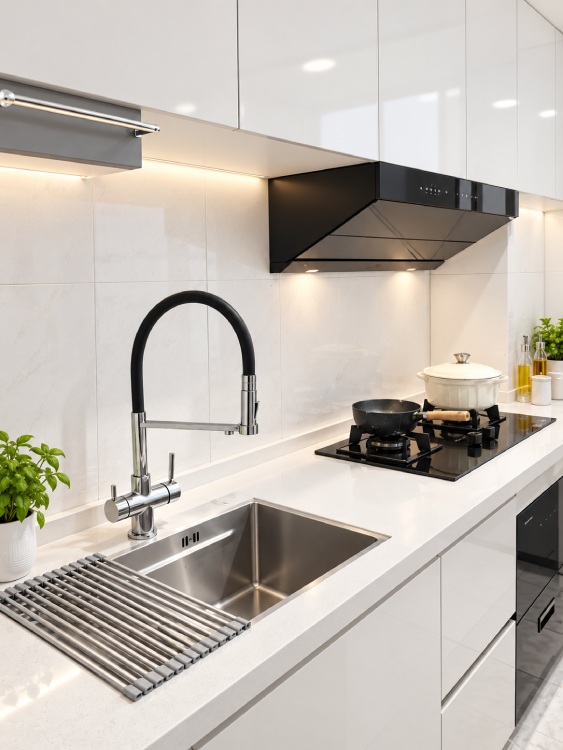
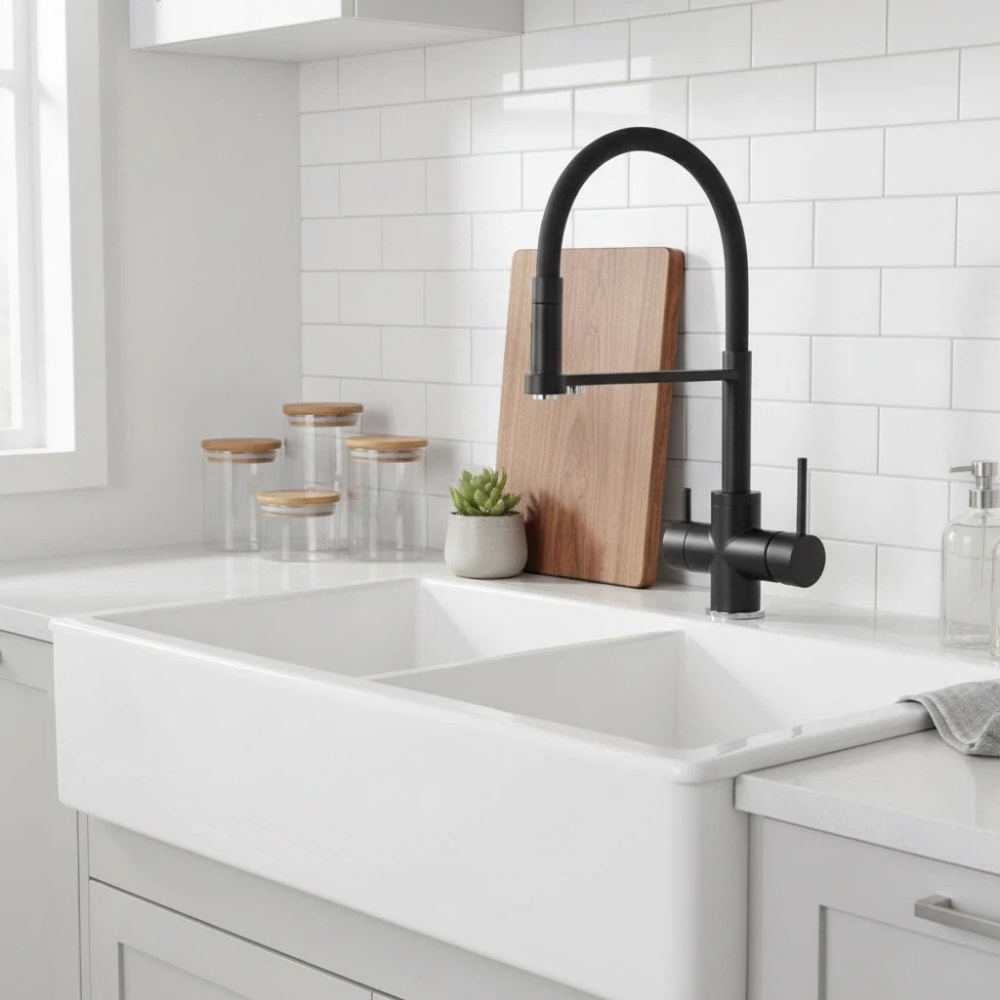
3-Way Kitchen Faucet
The structure is: hot and cold tap water + filtered drinking water, all using one kitchen faucet, while filtered water flows through an independent internal waterway.
Advantages:
- One main faucet can provide all functions
- Keeps the kitchen countertop cleaner
- No need to install an additional small drinking water faucet
- Drinking water and tap water remain in separate internal waterways and do not mix
If you care about keeping your countertop clean and uncluttered, a 3-way faucet is a more elegant solution.
This is also the difference between truly integrating an under sink water filter with a kitchen faucet and simply installing the two separately.
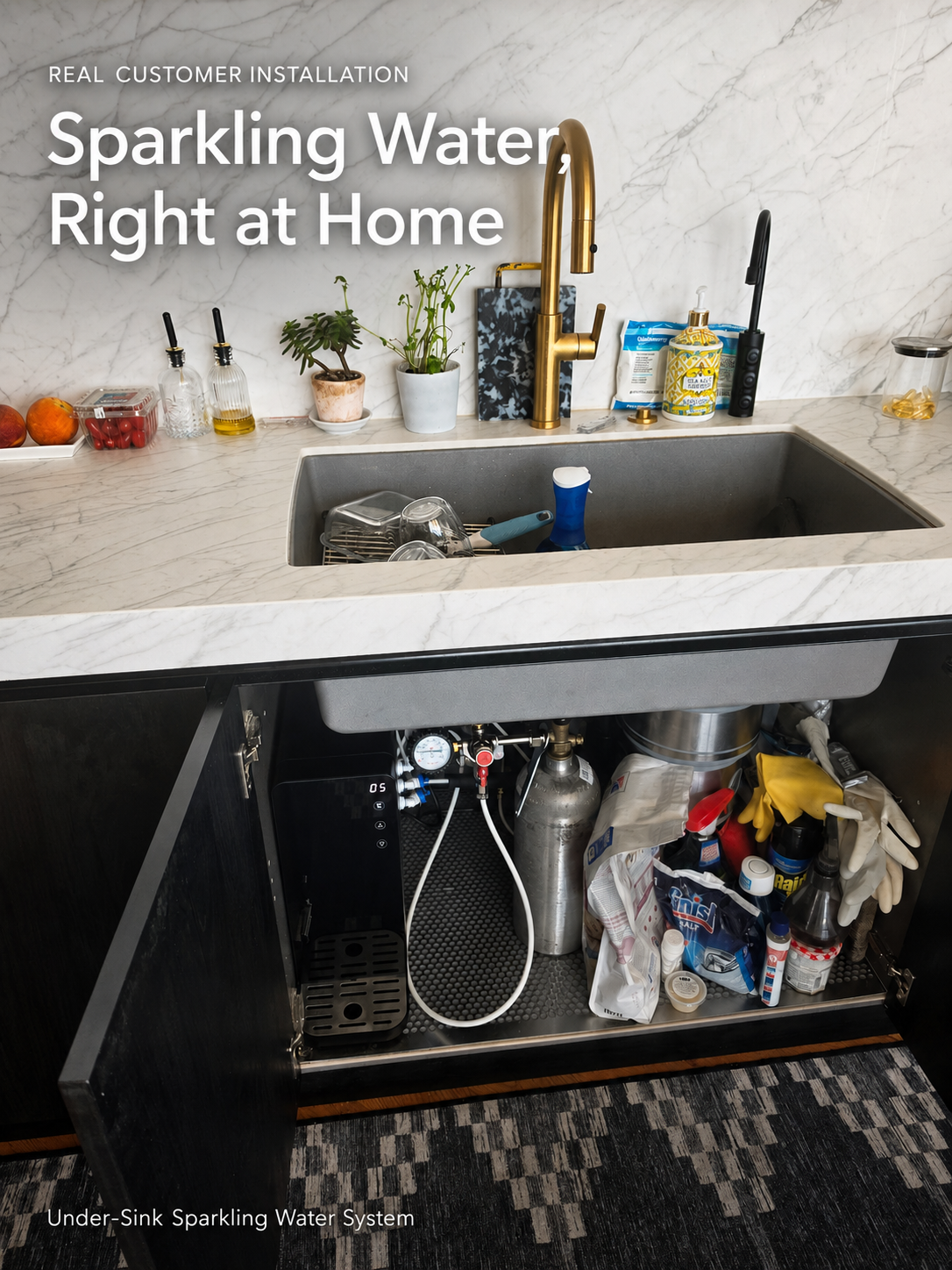
Can an Under Sink Water Filter Connect to a Sparkling Water Dispenser?
Yes, but several conditions need to be considered:
- Whether the connections are compatible
- Whether the water filter provides sufficient flow
- Whether the inlet water pressure is suitable
- Whether the filtration technology is appropriate for the appliance
The flow rate issue is particularly important: A sparkling water dispenser requires a continuous water supply for refilling. If the filtration system has a very low flow rate, it may affect:
- Refill speed
- Continuous-use experience
- Stable operation of the appliance
Therefore, high-flow water filters are more suitable for connecting to certain under-sink sparkling water systems. For example, the Liliumfaucet High-Flow Under-Sink Water Filter has a rated flow rate of 5–7 L/min, allowing it to provide a more comfortable continuous water supply for a sparkling water dispenser.
Related Product: Sparkling Water Dispenser Collection
How to Choose the Best Under Sink Water Filter for Your Home
If you do not want to get overwhelmed by specifications, follow these six steps and you will be much less likely to make the wrong choice.
Step 1: Understand Your Household Water Quality
It is recommended to check:
- Local municipal water quality reports
- Consumer Confidence Report, which U.S. municipal water suppliers publish annually
- Private well water testing reports
- Third-party water quality testing
One reminder: Do not judge water quality simply by taste. Many contaminants are colorless and odorless and can only be identified through testing data.
Step 2: Identify the Problem You Actually Want to Solve
Use the following list to identify your main concern:
- Noticeable chlorine taste → Consider carbon filtration
- High levels of sediment → Sediment filtration is needed
- Concern about certain health-related contaminants → Look for products with specific testing or certification for those contaminants
- High TDS → Consider RO
- Scale problems → Consider a system with scale inhibition
However, it is important to note that a scale inhibitor is not the same as a true water softener. It can only help reduce scale buildup and cannot fully soften water in the same way as a water softener.
Step 3: Determine the Water Flow Rate You Need
Factors to consider include:
- Household size
- Daily drinking water consumption
- How often you cook
- Whether you connect a sparkling water dispenser
- Whether you connect an instant hot water dispenser
- Whether you need fast water dispensing
Step 4: Measure the Under-Sink Installation Space
Do not only measure:
- Width
- Height
- Depth
You should also leave space for:
- Tubing
- Fittings
- Valves
- Filter replacement access
Step 5: Choose Your Kitchen Faucet Configuration
Depending on your countertop and preferences, choose from:
- Separate drinking water faucet
- Existing kitchen faucet, if compatible
- 3-way kitchen faucet
- Multi-functional kitchen faucet
Step 6: Calculate Long-Term Operating Costs
Compare all of the following:
- System price
- Filter cartridge price
- Filter cartridge lifespan
- Number of replacements per year
- Whether electricity is required
- Whether wastewater is produced
Do not look only at the initial purchase price. Use the annual filter cartridge cost formula mentioned above to calculate the real long-term cost before making a decision.
How Often Should You Replace an Under Sink Water Filter Cartridge?
Do not simply answer “once a year.” The actual situation is more complicated.
Factors that affect filter cartridge lifespan include:
- Household water consumption
- Local water quality
- Sediment levels
- Chlorine levels
- Water hardness
- Rated filter capacity
- Actual water flow rate
The following signs may indicate that it is time to replace the filter:
- Water flow noticeably decreases
- Water taste changes
- Noticeable odors appear
- The manufacturer's recommended replacement interval has been reached
- The rated filtration capacity has been reached
One final reminder: Filter cartridges should be replaced according to the manufacturer's specified time interval and capacity. Do not continue using them beyond the recommended period just to save money, as filtration performance may decline.
Which Type of Under Sink Water Filter Is Best for You?
If You Prioritize High Flow, Choose a High-Flow Single-Stage Water Filter
Suitable for:
- Municipal tap water
- Limited kitchen cabinet space
- Higher water flow requirements
- Mainly used for drinking and cooking
- Connecting to drinking water appliances such as sparkling water dispensers and instant hot water appliances
- Households that do not want wastewater
- Users who prefer simple maintenance
Recommended: Liliumfaucet Home High-Flow Under-Sink Water Filter
If You Want Multi-Layer Filtration, Choose a 2-Stage Water Filter
Suitable for:
- Users who want staged filtration
- Water with more noticeable sediment
- Households with sufficient cabinet space
- Users who want to balance filtration performance and water flow
Recommended: Liliumfaucet 2 Stage Under Sink Water Filter System
If Water Testing Shows That Deeper Treatment Is Needed, Consider RO
Suitable for:
- High TDS
- Specific dissolved contaminants that need to be reduced
- Users who can accept wastewater
- Users who can accept more maintenance
- Users who do not prioritize high water flow
FAQ
FAQ 1: What Is the Best Under Sink Water Filter?
There is no single product that is suitable for every household. You should consider your water quality, target contaminants, flow rate, installation space, maintenance cost, and use case. The best system is the one that suits your needs.
FAQ 2: Are Under Sink Water Filters Worth It?
The main advantages include filtered water on demand, no countertop space required, larger filter capacity than many water filter pitchers, better suitability for frequent household drinking water use, and reduced dependence on bottled water. In the long term, they can be a worthwhile investment for households with high daily drinking water consumption.
FAQ 3: Is a 2-Stage Water Filter Always Better Than a Single-Stage Water Filter?
Not necessarily. Filtration performance mainly depends on the filter media used, the contaminants that need to be addressed, and the performance of the filter cartridge itself, rather than simply the number of filtration stages.
FAQ 4: Which Is Better, RO or a Standard Under Sink Water Filter?
The two technologies solve different problems. Standard under sink water filters are usually more suitable for municipal tap water, high-flow needs, improving chlorine-related taste and odors, and simple maintenance. RO is more suitable for situations where certain dissolved contaminants need to be reduced or TDS is high.
FAQ 5: How Long Does an Under Sink Water Filter Cartridge Usually Last?
It depends on the filter capacity, household water consumption, water quality, and sediment levels. Both the recommended replacement interval and the manufacturer's rated filtration capacity should be considered.
FAQ 6: Will an Under Sink Water Filter Reduce Water Pressure?
All filtration systems create some degree of resistance, but high-flow water filters can help minimize the impact on daily water use.
FAQ 7: Can an Under Sink Water Filter Connect to an Existing Kitchen Faucet?
It depends on the faucet structure. Some systems can connect to an existing faucet, while others require a separate drinking water faucet or a multi-way faucet with an independent filtered waterway.
FAQ 8: Can an Under Sink Water Filter Connect to a 3-Way Kitchen Faucet?
Yes. The 3-way kitchen faucet must have a separate filtered water inlet and an independent filtered waterway so that filtered drinking water does not mix with hot and cold tap water inside the faucet.
FAQ 9: Can an Under Sink Water Filter Remove PFAS?
You cannot generally say that all water filters can remove PFAS. You should check whether the specific product has been tested for the relevant PFAS contaminants and review the corresponding certification and reduction claims.
FAQ 10: Does an Under Sink Water Filter Require Electricity?
Many traditional carbon and sediment filtration systems do not require electricity. Some tankless RO systems and systems with booster pumps do require a power supply.
Conclusion
The first step in choosing the best under sink water filter for your home is always to understand your household water quality and identify the problem you actually want to solve.
- For households that want higher water flow, simple maintenance, no wastewater, compact installation, and compatibility with 3-way kitchen faucets or other drinking water appliances, a high-flow under-sink filtration system may be a more suitable choice.
- If you want layered treatment using different filtration media, you can consider a 2-stage filtration system.
- If water quality testing shows high TDS or specific dissolved contaminants, you can further consider an RO system.
There is no universally “best water filter.” There is only the one that best suits your household water quality and usage habits.