When setting up a home water system, one common question is: “Can a 3 way kitchen faucet connect to an RO system?” The answer is yes. A 3 way kitchen faucet can work with an RO system. However, there is one important condition: the faucet must have a separate filtered water inlet and a dedicated internal waterway. Only when this condition is met can a 3 way kitchen faucet and an RO system connect effectively and work together properly.
In real-life kitchens, many households face the same problem: they do not want to install an additional small drinking water faucet for their RO system. Kitchen space is often limited, and an extra faucet not only takes up more countertop space but may also affect the overall style and visual harmony of the kitchen. In addition, purchasing and installing an extra faucet can increase the overall cost.
Based on these common user pain points, this article provides practical value. Next, we will explain how a 3 way kitchen faucet connects to an RO system, discuss the key compatibility requirements, outline important installation considerations, and provide a practical guide to choosing the right RO-compatible 3 way faucet for your home water system.
What Is a 3 Way Kitchen Faucet?
A 3 way kitchen faucet is a kitchen faucet with a special waterway design that provides three different water options.
In general, these three water paths are:
- Hot water: Used for tasks such as washing dishes, softening grease, or preparing drinks that require hot water.
- Cold water: Used for everyday kitchen tasks such as washing vegetables, rinsing rice, and general cleaning.
- Filtered drinking water: Water that has been filtered and can be used for direct drinking, providing the household with safer and cleaner drinking water.
A 3 way kitchen faucet may also be called a 3 in 1 kitchen faucet, a 3 way filter faucet, or a kitchen faucet with filtered water. It is important to note that a 3 way kitchen faucet does not mix these three types of water together. Instead, it uses carefully designed separate water paths to control different water functions. Users can conveniently switch between different types of water according to their needs.
Taking the Liliumfaucet 3 way kitchen faucet as an example, its design integrates hot water, cold water, and filtered water into one main faucet. This design fits well with the needs of modern kitchen upgrades. It helps save kitchen space while giving users multiple water options, improving both convenience and functionality. It is a practical choice for modern kitchen renovation and upgrades.
How Does an Under-Sink RO System Work?
RO stands for Reverse Osmosis. It is a commonly used system for purifying drinking water. In simple terms, it works like a highly precise “water sieve” that helps block impurities, bacteria, heavy metals, and other unwanted substances in the water, allowing cleaner water molecules to pass through and providing safe drinking water for the household.
An RO system mainly relies on a filtration membrane to treat drinking water. This membrane is extremely fine. Only water molecules and a very small amount of beneficial ions can pass through, while various impurities are blocked.
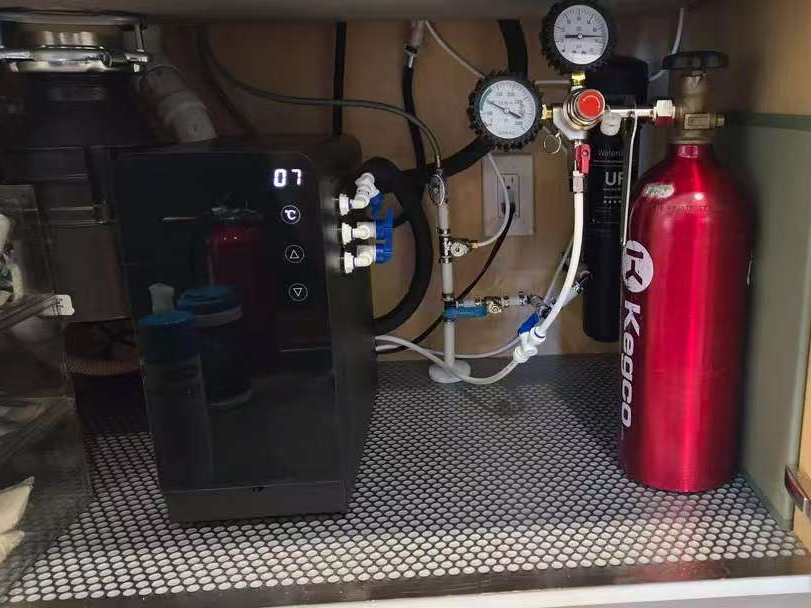
In most homes, an RO system is installed under the kitchen sink. This location makes it convenient to connect to the water supply and drainage while keeping the system hidden so it does not affect the overall appearance of the kitchen.
A complete RO system usually includes the following parts:
- Cold water supply connection: This connects the home’s cold water supply line to the RO system and provides the raw water that needs to be treated. It is like continuously sending water into the “water sieve” for filtration.
- RO filtration unit: This contains the key filtration membrane and acts as the core “purification center” of the system. Raw water passes through multiple layers of filtration here and becomes cleaner.
- Storage tank or tankless system: Some RO systems come with a storage tank, where filtered water is stored for later use. Other systems are tankless and produce fresh drinking water in real time without storing it.
- Drinking water outlet line: This line delivers the treated RO drinking water to the point where it will be used.
- Drain line: This line discharges the wastewater produced during the RO filtration process.
The key point is that an RO system ultimately needs to connect to a drinking water outlet so users can access the purified water. A 3 way faucet can serve this function by providing a convenient outlet for the drinking water treated by the RO system, allowing users to easily access clean drinking water.
Can a 3 Way Kitchen Faucet Connect to an RO System?
Yes, in most cases it can. However, to connect a 3 way kitchen faucet to an RO system, the following three conditions must be met.
1. The Faucet Must Have a Separate Filtered Water Inlet
A 3 way faucet should have an independent filtered water inlet, also known as an RO water inlet. This is the key to ensuring that the RO system can connect properly to the faucet. The purified water outlet from the RO system connects to this dedicated filtered water connection.
It is very important not to connect RO water to the regular hot and cold mixed water lines. Otherwise, the purity of the RO water cannot be guaranteed, and the purpose of the connection will be lost. Only through this separate inlet can the purified water from the RO system enter the faucet smoothly and without contamination, providing safe drinking water for the user.
2. The Faucet Should Have a Dedicated Internal Waterway
A high-quality 3 way faucet should allow filtered water to flow through an independent internal waterway. This thoughtful design prevents RO water from mixing with unfiltered tap water and helps protect the purity of the filtered water.
This is exactly one of the key trust points users care about most. Many people worry about questions such as: “Will filtered water mix with tap water?” and “Is it safe to drink RO water from the same faucet?” A dedicated internal waterway addresses these concerns from the inside of the faucet, allowing users to drink filtered water with greater confidence.
3. The Connector Size Must Match Your RO System
The common tubing size for many RO systems is 1/4 inch, which is widely used internationally. Before installation, it is important to understand the connector size used by your RO system, because a small number of RO brands may use their own connection sizes.
If the sizes do not match, there is usually no need to worry too much. In many cases, an adapter can be used to connect the two parts securely.
How a 3 Way Faucet Supplies Hot Water, Cold Water, and RO Water
A 3 way faucet provides different types of water by clearly separating three water paths:
| Water Type | Source | Faucet Function |
|---|---|---|
| Hot water | Home hot water line | Regular washing and cooking |
| Cold water | Home cold water line | Regular washing and cleaning |
| RO filtered water | Under-sink RO system | Drinking water |
Regular Tap Water and RO Water Stay Separate
In most cases, hot and cold water come out through the main mixing function to meet everyday needs such as washing and cleaning at different water temperatures. RO water flows through a separate drinking water channel, which ensures that the RO filtered water remains pure and does not mix with regular tap water.
This is also the main difference between a 3 way faucet and a regular kitchen faucet. A regular kitchen faucet usually only provides mixed hot and cold water and cannot directly provide RO filtered drinking water.
One Faucet, No Extra Drinking Water Faucet
In a traditional RO system, a separate small faucet often needs to be installed beside the sink specifically for RO filtered drinking water. A 3 way faucet changes this setup. It combines hot water, cold water, and RO filtered water into one faucet, reducing the number of holes required on the countertop.
This feature is especially attractive for kitchens with granite countertops, quartz countertops, kitchen islands, or apartment kitchens. In these situations, kitchen space may be limited, or the homeowner may have higher expectations for countertop appearance and space efficiency. A 3 way faucet meets multiple water needs while avoiding countertop clutter caused by too many faucets. It improves both practicality and visual appeal in the kitchen.
3 Way Faucet vs Separate RO Faucet: Which Is Better?
To help you make a decision, here is a comparison table:
| Option | Pros | Cons | Best For |
| 3 way kitchen faucet | Cleaner appearance, no extra drilling, hot water, cold water, and RO water in one faucet | Requires correct connector compatibility | Modern kitchens, kitchen renovations, and limited sink space |
| Separate RO faucet | Designed only for RO water and easy to replace | Requires an extra hole and makes the sink area look more crowded | Existing RO systems with an extra sink hole |
| Regular faucet only | Lower cost | Not suitable for separated direct RO drinking water | Homes without an RO system or filtered water needs |
In conclusion, if you are renovating your kitchen, want a clean and attractive kitchen layout, or do not want to drill an extra hole in the countertop, a 3 way faucet is the better choice. It not only meets different water needs but also uses space more efficiently and improves the overall appearance of the kitchen.
If your home already has a separate hole reserved for an RO faucet, continuing to use a separate faucet is also a workable option and can maintain your existing usage habits.
However, when considering both appearance and user experience, a 3 way faucet is undoubtedly more modern and can bring a more convenient and stylish water experience to the kitchen.
Will RO Water Flow More Slowly from a 3 Way Faucet?
In general, RO water flow is indeed slower than regular tap water. However, this is mainly due to the characteristics of the RO system itself and is not necessarily a faucet problem.
An RO system filters water through a semi-permeable membrane. Only water molecules and a small amount of ions can pass through, and this process is relatively slow. As a result, the flow rate of RO filtered water is usually lower than that of regular tap water.
The following are some key factors that affect RO water flow speed:
- RO storage tank pressure: If the storage tank pressure is insufficient, it cannot effectively push the stored RO water out, resulting in slower flow. This is similar to how household water flow becomes weaker when water pressure is low.
- Filter condition: After long-term use, RO filters gradually collect a large amount of impurities and may become clogged. When the filter is seriously clogged, it becomes harder for water to pass through, and the flow rate naturally decreases. This is similar to a filter screen being blocked by debris.
- Tubing size: If the tubing connected to the RO system is too small, it can restrict water flow. Just like a narrow river channel cannot allow a large amount of water to pass quickly, narrow tubing can prevent RO water from flowing smoothly.
- Inlet water pressure: The pressure of the tap water entering the RO system directly affects the speed of RO water production. If the inlet water pressure is low, the RO system does not have enough force to filter and dispense water, and the flow rate will decrease.
- Type of RO system, tank or tankless: A tankless RO system usually produces water in real time, and its water output depends on the system’s production capacity. By comparison, a system with a tank may provide relatively stable flow for a short period when the tank is full. However, if the tank runs low and the system cannot produce water quickly enough, the water flow may also slow down.
If you notice that the RO water flow is too slow, you should first check the above parts of the RO system instead of immediately assuming that the faucet is the problem. Only by checking each component of the RO system step by step can you accurately identify the reason for slow flow and solve it.
Installation Checklist Before Connecting a 3 Way Faucet to an RO System
Before connecting a 3 way faucet to an RO system, be sure to check the following items carefully. This can help ensure a smooth installation and make the setup more practical and reliable.
Check the Number of Water Lines
Confirm that the faucet includes the following water lines:
- Hot water hose: Make sure it is intact and can connect properly to the home’s hot water supply line to provide hot water to the faucet.
- Cold water hose: This connects to the cold water supply line and ensures smooth cold water flow.
- Filtered water hose: This is specifically used to connect to the water filtered by the RO system. It is the key line that allows the 3 way faucet to provide RO filtered water.
Check the Connector Size
- Check the RO outlet tubing size: Carefully measure the size of the outlet tubing from the RO system. This is the basis for determining whether it matches the faucet’s filtered water connector.
- Check the faucet filtered water connector size: At the same time, check the size of the filtered water connector on the 3 way faucet to make sure it matches the RO outlet tubing.
- Prepare the right adapter: If the RO outlet tubing size does not match the faucet filtered water connector, prepare the appropriate adapter to create a secure connection and avoid problems such as leaking.
Check the Sink Hole Size
A 3 way faucet is generally used to replace the main kitchen faucet. Before installation, confirm the size of the existing hole in the sink or countertop.
If your countertop originally has only one main faucet hole, a 3 way faucet may be a more suitable choice because it does not require additional drilling. This can save installation time and cost while avoiding unnecessary damage to the sink or countertop.
Check Whether Your RO System Requires an Air Gap Faucet
In some regions, or with certain types of RO systems, an air gap faucet may be required. If your RO system clearly requires this, you must confirm whether the 3 way faucet you choose supports an air gap function.
To avoid installation problems, it is recommended that you carefully check the user manual of your RO system for detailed air gap faucet requirements. If you are still unsure, you can also consult a professional plumber for accurate guidance.
Is a Pull Out 3 Way Kitchen Faucet Suitable for an RO System?
The answer is yes, if it has a dedicated filtered water line.
The pull-out function of a pull out 3 way kitchen faucet is mainly designed for cleaning with regular hot and cold water. For example, when cleaning the corners of the sink or rinsing large pots and pans, a pull-out faucet allows users to adjust the water direction and rinsing angle more flexibly, making cleaning more thorough and convenient.
RO filtered water is usually controlled through a separate drinking water outlet. This design ensures that RO filtered water is not affected by the pull-out function and remains clean and sanitary for direct drinking.
A pull out 3 way kitchen faucet has several advantages:
- More convenient sink cleaning: The pull-out function can easily reach different corners of the sink. Whether you are rinsing food residue from the bottom of the sink or cleaning the edges, it makes the process easier and more efficient.
- Better for large single-bowl sinks: In a large single-bowl sink, cleaning large cookware can be more convenient. A pull-out faucet can better adapt to different cleaning needs by allowing the water flow to move freely and reach more areas.
- More suitable for modern kitchens: The stylish appearance and flexible operation of this type of faucet match the clean and efficient design style of modern kitchens, adding a modern touch to the space.
- At the same time, it still keeps the RO drinking water function. While meeting everyday cleaning needs, it also provides users with safe and healthy drinking water, making it a practical choice for modern kitchens connected to RO systems.
.jpg?w=500&h=375)
Common Mistakes When Connecting a 3 Way Faucet to an RO System
Mistake 1: Ignoring Connector Size
A mismatch in connector size is an easy mistake to make and can lead to serious problems. The RO system tubing and the filtered water connector of the 3 way faucet must match accurately.
If this is ignored during installation, you may face installation difficulties, such as being unable to connect the two parts properly. Even if they are forced together, leaks may occur. This not only wastes water but may also damage cabinets and nearby areas over time.
Therefore, before ordering a 3 way faucet, always carefully confirm the connection specifications of both the RO system tubing and the faucet’s filtered water connector to ensure they are fully compatible.
Mistake 2: Expecting RO Water Flow to Be the Same as Regular Tap Water
Many users become confused when the RO water flow from a 3 way faucet is slower than expected. Some may even think the faucet or RO system is faulty.
In fact, RO water flow is usually slower than regular tap water. This is normal, especially for tank-based RO systems. An RO system purifies water through a special filtration membrane, and this process is relatively complex and time-consuming. As a result, the amount of RO water produced is limited.
Users should not expect RO water to flow at the same rate as regular tap water. If the flow is only slightly slower and there are no other issues, there is usually no need to worry too much.
Mistake 3: Connecting RO Water to the Wrong Inlet
When connecting a 3 way faucet to an RO system, accuracy is essential. The outlet from the RO system must connect to the dedicated filtered water inlet on the 3 way faucet.
Never connect RO water to the hot and cold mixed water lines. Otherwise, the RO filtered water will mix with regular tap water, and its purity cannot be guaranteed. This defeats the purpose of installing an RO system and a 3 way faucet for clean drinking water.
During installation, carefully identify each connector and follow the correct connection method.
How to Choose the Best 3 Way Kitchen Faucet for an RO System
When buying a 3 way kitchen faucet for an RO system, users should pay attention to the following key points:
- Dedicated filtered water channel: Make sure the faucet has a dedicated filtered water channel. This helps ensure that RO filtered water stays pure and does not mix with other water sources, meeting the need for safe drinking water.
- RO-compatible connector: The faucet connector must be compatible with the RO system. A properly matched connector size can help avoid installation problems such as leaks and difficult connections.
- Lead-free and safe materials: The faucet should be made from lead-free and safe materials to protect drinking water quality and avoid potential health risks caused by faucet materials.
- Ceramic cartridge: A ceramic cartridge offers good wear resistance and sealing performance. It can help extend the service life of the faucet, reduce the risk of leakage, and provide stable water flow control.
- Pull-out or fixed spout design: Choose according to personal habits and actual kitchen needs. A pull-out spout can flexibly adjust the water direction, making it easier to clean all corners of the sink and rinse large items. A fixed spout is simpler and takes up less space.
- Finish options: Finishes such as matte black, brushed nickel, chrome, and stainless steel affect not only the faucet’s appearance but also its durability and ease of cleaning. Choose a finish that matches the overall kitchen style.
- Installation hole requirements: Check the faucet’s installation hole requirements and compare them with your existing sink or countertop hole. This helps avoid installation difficulties or the need for additional drilling.
- After-sales support: Good after-sales support can help users solve different problems during use and provide timely repair or replacement support, making the product easier to use with confidence.
- Whether adapters are included: If the connector size between the RO system and the faucet may differ, included adapters can make installation much easier and save time and cost.
Best for Modern Kitchens
For modern kitchen renovations, open kitchens, and kitchens with large sinks, a pull-out 3 way faucet is recommended. The pull-out design provides greater flexibility. When cleaning a large sink or oversized cookware, users can easily pull out the spray head, adjust the water angle, and reach all areas of the sink to meet different cleaning needs.
Its stylish appearance also matches modern kitchen design and improves both the appearance and practicality of the kitchen.
Best for Minimalist Countertops
For minimalist countertop designs, the key advantage is “no extra faucet hole” and “no separate drinking water faucet.” Choosing this type of 3 way faucet can effectively reduce the number of countertop holes and avoid the clutter caused by too many faucets, keeping the countertop clean and simple.
This design not only fits a minimalist look but also makes better use of countertop space, helping the kitchen appear cleaner and more organized.
Best for Existing RO Systems
If you already have an RO system, it is especially important to confirm the RO tubing size and adapter compatibility when choosing a 3 way faucet.
First, accurately measure the size of the RO system tubing. Then choose a faucet that matches it and confirm whether the included adapter can work well with the existing RO system. Only in this way can you ensure that the new 3 way faucet connects smoothly to the current RO system and avoids installation problems caused by size mismatch or adapter incompatibility.
Final Answer: Should You Use a 3 Way Faucet with an RO System?
The core answer is: yes, it can work very well. However, to make the setup work properly, the following key conditions should be met:
- Separate filtered water inlet: The 3 way faucet must have a separate filtered water inlet. This allows the purified water from the RO system to connect correctly and ensures an independent drinking water supply without confusion with other water lines.
- Dedicated internal waterway: A dedicated internal waterway ensures that RO filtered water does not mix with unfiltered tap water inside the faucet, helping protect water purity from the faucet’s internal structure.
- Proper installation: Proper installation is the key to ensuring that the entire system works normally. From water line connection and sealing to the assembly of each component, everything should be done according to the correct procedure. Otherwise, even if the faucet and RO system themselves are suitable, various problems may still occur.
From a practical and conversion-focused perspective, if users want a cleaner kitchen countertop, do not want to install an extra small faucet for RO drinking water, and still want to enjoy high-quality drinking water filtered by an RO system, then a 3 way kitchen faucet is a very practical upgrade. It combines multiple water functions, reduces countertop clutter, and meets the household’s different water needs, bringing more convenience and comfort to everyday kitchen life.
.webp?w=1000&h=1000)