
For a long time, the “standard configuration” of a kitchen faucet was simple: two handles and one spout—hot water, cold water, and nothing more. Turn it on, adjust the temperature, turn it off. For decades, no one really felt that anything was missing.
But today, the way households use water in the kitchen has changed completely.
More and more families are realizing that what they really want at the kitchen sink is a combination of functions like these:
- Regular hot and cold water — the foundation for washing vegetables, doing dishes, and everyday cleaning.
- Filtered drinking water — for direct drinking, cooking soup, or preparing formula without having to boil water and wait for it to cool.
- Chilled water — for filling a glass with cold drinking water whenever you want, especially in summer.
- Sparkling water — for making soda water and mixed drinks at home without storing cases of bottled sparkling water.
- Boiling water — for tea, coffee, blanching vegetables, and other tasks that benefit from instant hot water.
- Pull-out rinsing — for reaching sink corners, large pots, and fresh produce by giving the faucet a much wider working range.
In the past, what would it take to meet all six of these needs?
It often meant installing an under-sink water filter, a water dispenser or instant hot water unit, a sparkling water machine, and then adding a pull-out kitchen faucet. The countertop became crowded with equipment, the plumbing underneath became complicated, each appliance required separate maintenance and replacement parts, and several of them needed their own power outlet.
The Multi function kitchen faucet was created to solve exactly this problem.
Its real value is not that “one faucet has lots of buttons.” More buttons alone are just a feature. What truly matters is integration: bringing functions that once required multiple faucets and separate drinking-water appliances together at one kitchen water point.
One outlet, multiple water functions, and the ability to switch between them as needed. The countertop becomes cleaner, the system becomes more integrated, and the overall kitchen experience moves from “good enough” to something much more convenient.
So this guide is not here to tell you whether a multi function kitchen faucet “sounds cool.” Instead, it will help answer three much more practical questions:
- How many functions do you actually need? Do you only need pull-out functionality plus filtered water, or do you also want chilled, sparkling, and boiling water?
- How are these functions achieved? What kinds of waterway designs, heating methods, and filtration systems are behind them, and how do they affect everyday use and long-term costs?
- Which specifications should you pay attention to? Which factors—such as cartridges, materials, water modes, and installation requirements—affect durability, which affect the user experience, and which may simply add cost?
Let’s break them down one by one.
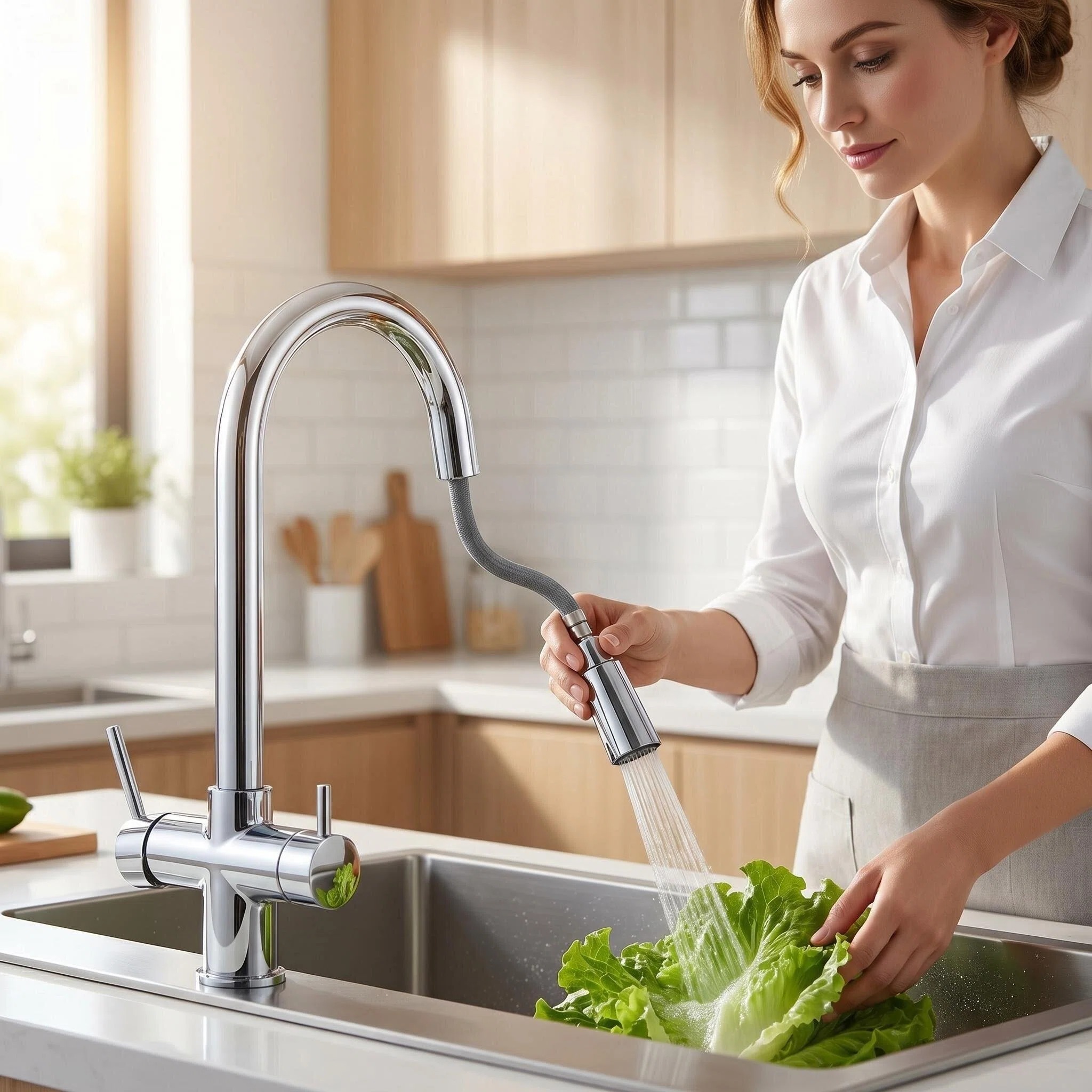
What Is a Multi Function Kitchen Faucet?
A Multi function kitchen faucet is, simply put, a kitchen faucet that adds drinking-water or other practical functions on top of the traditional hot/cold kitchen mixer.
The basic job of a conventional faucet is straightforward: deliver water, mix hot and cold water, adjust temperature, and control flow. A multi function kitchen faucet still performs those same basic tasks, but it brings additional water functions into the same faucet.
Common additional functions include filtered water, RO water, chilled water, sparkling water, boiling water, and a pull-out sprayer.
In other words, the same faucet can be used to wash vegetables, dispense filtered drinking water, provide chilled water in summer, serve sparkling water when entertaining guests, or provide boiling water for tea—all without installing a second or third faucet at the sink.
However, there is one very important point to understand before shopping:
“Multi-function” is not a fixed standard for the number of water functions or waterways.
It is a broad product category, just as the term “multifunction smartphone” does not mean that every phone has exactly the same feature set.
Products on the market may be described as 3-way, 4-way, 5-way, or other multifunction configurations.
For example:
- 3-way may refer to hot, cold, and filtered water.
- 4-way may refer to hot, cold, filtered, and boiling water.
- 5-way may refer to hot, cold, filtered, sparkling, and boiling water.
Even though all of these products may be marketed as “multifunction,” the actual combination of water functions, internal waterway design, cartridge structure, installation requirements, and long-term operating costs can be very different.
So do not treat a Multi function kitchen faucet and a 3-way faucet as the same thing.
A 3-way faucet is simply one specific configuration within the multifunction faucet category. “Multi-function” itself covers a broader range of products with different combinations of water functions.
Understanding this distinction helps you avoid being distracted by the word “multifunction” and instead compare each product against your actual needs—whether it offers exactly what you need, more than you need, or is missing an important function.
How Does a Multi Function Kitchen Faucet Work?
Once you understand what “multi-function” actually means, the next question is obvious: how can so many functions be integrated into one faucet?
The key lies in the waterway design.
Inside a multi function kitchen faucet, water is not necessarily carried through one single channel from inlet to outlet. Instead, the faucet typically separates ordinary hot/cold mixed water from dedicated drinking-water pathways.
Standard Hot and Cold Waterway
Let’s start with the basic function found in almost every kitchen faucet.
The standard hot and cold waterway is relatively simple: the hot-water supply and cold-water supply connect to the faucet body, where a mixer cartridge controls the mixture.
Inside the cartridge are precision ceramic discs. When you rotate or lift the handle, the relative position of these ceramic discs changes, which adjusts the amount of hot and cold water flowing through the faucet.
More cold water lowers the temperature. More hot water raises it.
The mixer cartridge usually performs two jobs at the same time: controlling temperature and controlling flow.
It is also one of the hardest-working components in the entire faucet, because it may be opened and closed hundreds of thousands of times during its service life. For this reason, cartridge quality plays an important role in the faucet’s long-term durability.
This waterway handles the highest-frequency, everyday kitchen tasks—washing vegetables, washing dishes, and general cleaning.
Dedicated Drinking Waterway
A well-designed filtered water faucet normally does not send drinking water through exactly the same internal path used for ordinary mixed hot and cold water.
Instead, it uses a dedicated waterway for filtered drinking water.
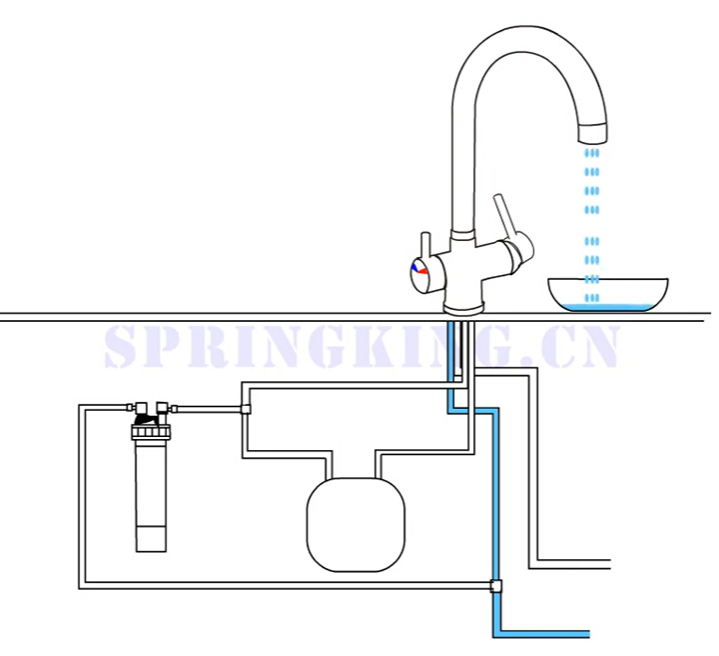
Filtered water leaves the under-sink filtration system and travels through its own tubing and internal channel before reaching the drinking-water outlet. It does not need to pass through the ordinary hot/cold mixer cartridge.
The reason for this design is practical.
A mixer cartridge has a more complex internal structure and repeatedly handles hot and cold mains water. Over time, mineral deposits and residues can build up within ordinary water passages. Sending filtered water through a separate pathway helps keep the drinking-water route isolated from the regular mixed-water system.
This is why “dedicated waterway” is so often emphasized in 3-way faucet products.
It is not simply a marketing phrase. It is an important structural feature for keeping filtered drinking water separate from ordinary tap water.
The Under-Sink System Is What Actually Treats the Water
There is another important point that needs to be emphasized:
Although it may look as if all of the functions are built directly into the faucet, the faucet itself usually does not perform the actual water treatment.
The real water-treatment work happens in the system installed underneath the cabinet.
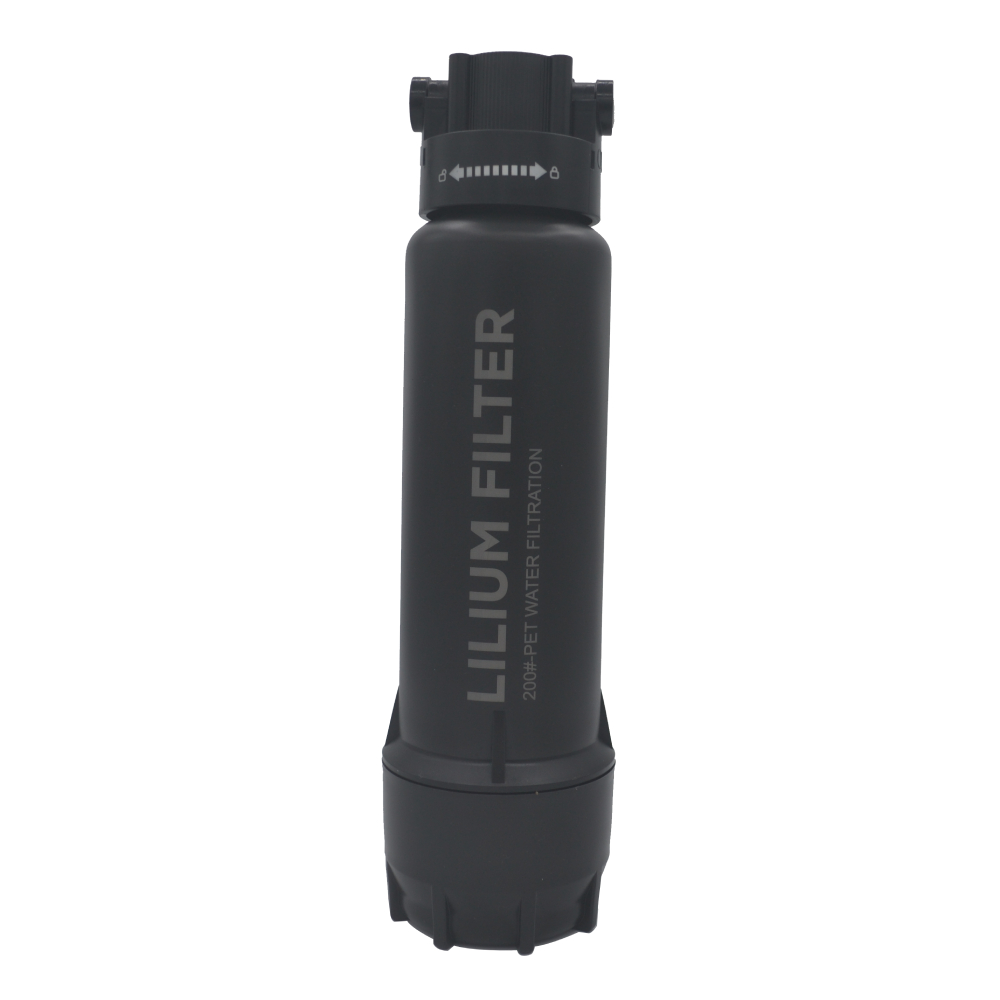
- The water filter performs filtration.
- The chiller cools the water.
- The carbonator, together with a CO₂ cylinder, produces sparkling water.
- The boiler prepares water for boiling-water dispensing.
Each additional water function is supported by corresponding equipment under the sink.
The faucet itself mainly performs two jobs:
control and dispensing.
When you press a button, turn a control, or select a particular function, the faucet opens the corresponding water path and delivers the water that has already been treated by the under-sink system.
This is one of the strengths of the multi function kitchen faucet concept.
The treatment systems remain underneath the counter, while the faucet acts as the control and dispensing point above the sink.
To summarize this section in one sentence:
Hot and cold water are controlled through the mixer cartridge, drinking water uses a dedicated waterway, and the actual water treatment happens under the sink—the faucet is the final control and dispensing point.
Once you understand these three layers, it becomes much easier to read the specifications and plumbing diagrams of any multi function kitchen faucet.
What Types of Multi Function Kitchen Faucets Are Available?
A multi function kitchen faucet is not one standardized product. It is an entire product category.
One common way of describing these faucets is by the number of water functions they provide, such as 3-way, 4-way, and 5-way.
The exact meaning of these terms can vary by manufacturer, so the number should always be checked against the actual functions listed for the product.
3-Way Kitchen Faucet
The 3-way kitchen faucet is one of the most common and accessible types in the multifunction faucet category.
A typical configuration is:
Hot + Cold + Filtered Water
It is especially suitable for households that already have an under-sink water filter or RO system but do not want to install a separate small drinking water faucet on the countertop.
For these users, the requirement is simple: the filtration system is already installed, and they simply want to connect filtered water to the main kitchen faucet so that washing and drinking water can come from the same faucet location.
One important point remains:
Even in a 3-way faucet, ordinary hot/cold water and filtered water should be separated through dedicated internal pathways.
Filtered drinking water should not simply be routed through the same mixing path as ordinary hot and cold water.
When shopping, check whether the product clearly states that it uses a dedicated drinking-water channel.
4-Way Kitchen Faucet
A 4-way kitchen faucet adds another water function beyond a typical 3-way setup.
However, there is one very important reality:
There is no single industry-wide standard defining exactly which four functions a “4-way” faucet must provide.
One product may offer:
Hot + Cold + Filtered + Chilled
while another may offer:
Hot + Cold + Filtered + Sparkling
The exact combination depends on the manufacturer’s design.
For this reason, consumers should not choose a faucet simply because it is labeled “4-way.”
That label tells you that the faucet supports multiple water functions, but it does not necessarily tell you which four functions are included.
The correct approach is to check the manufacturer’s clearly listed water functions and make sure the combination includes the water you actually want.
If the function you need is missing, having more functions overall does not help. And if one of the additional functions is something you will never use, you may simply be paying for a feature you do not need.
5-Way Kitchen Faucet
A 5-way kitchen faucet is a common high-end multifunction configuration.
One typical combination is:
- Hot water
- Cold water
- Filtered ambient water
- Chilled water
- Sparkling water
The logic behind this combination is straightforward.
Hot and cold water cover everyday cooking and cleaning. Filtered water handles regular drinking needs. Chilled and sparkling water add convenience for cold drinks, homemade beverages, and entertaining guests.
For this reason, a 5-way system is particularly suitable for households that regularly drink sparkling or chilled water while still wanting the full functionality of a traditional kitchen faucet.
It can bring a very broad range of kitchen water needs together at one dispensing point.
The trade-off is higher cost and greater under-sink space requirements because the system may need filtration, chilling, carbonation equipment, and a CO₂ cylinder. Before installation, sufficient cabinet space and access to power should be planned in advance.
What Is the Difference Between a 3-Way, 4-Way, and 5-Way Kitchen Faucet?
A comparison table can make the differences much easier to understand:
| Type | Common Water Functions | Typical Under-Sink Equipment | Best For |
|---|---|---|---|
| 3-Way | Hot + Cold + Filtered | Filter / RO | Everyday filtered drinking water |
| 4-Way | Hot + Cold + Two drinking-water functions | Filter + equipment required for the additional function | Households upgrading their drinking-water experience |
| 5-Way | Hot + Cold + Filtered + Chilled + Sparkling, etc. | Filter + Chiller + CO₂ | Frequent chilled or sparkling water users |
| Boiling Multifunction | Hot + Cold + Filtered + Boiling, etc. | Filter + Boiler | Tea, coffee, and cooking |
The most important point is this:
Do not choose based on the number alone. Choose according to the water functions you actually need.
What Are the Advantages of a Multi Function Kitchen Faucet?
Once you understand the different types of multi function kitchen faucets, a more practical question comes next:
Is it actually worth upgrading?
The answer starts with the core advantages.
The value of a multifunction faucet is not simply that it has more buttons or more water options. Its real advantage is that it changes the way water is organized and used in the kitchen, from countertop layout to everyday workflow.
These are five of its most important benefits.
One Faucet Integrates Multiple Types of Water
The most direct advantage of a multi function kitchen faucet is that one faucet can replace several separate dispensing fixtures.
In the past, a fully equipped kitchen sink area might have included several different items:
a main faucet, a filter faucet, a sparkling water tap, and a boiling water tap.
Each had its own outlet, controls, and plumbing.
The result could be a crowded countertop and a less unified appearance.
A multi function kitchen faucet combines these functions into one faucet body and one main dispensing point. You simply select the type of water you need.
The countertop becomes cleaner, and there is no longer a row of separate faucets competing for space.
Fewer Faucets on the Kitchen Countertop
This advantage deserves special attention because it is one of the most obvious improvements for many households.
Traditional RO systems often include a small separate drinking water faucet installed on the sink or countertop.
For decades, this has been a standard approach in the water-filtration industry.
A 3-way kitchen faucet changes that setup by integrating filtered water into the main kitchen faucet.
You keep the filtered water function, retain the full functionality of the main faucet, and eliminate one extra drinking-water faucet, one additional countertop hole, and some extra visible hardware.
For households that already have a water filter and do not want another small faucet beside the sink, this can be one of the most practical reasons to choose a multi function kitchen faucet.
Keeps Filtered Water Separate from Regular Water
A multi function kitchen faucet does not simply place multiple functions together.
A well-designed model also keeps filtered water separate from ordinary hot and cold water internally.
With a dedicated internal waterway, filtered water travels from the filtration system to the outlet through its own path and does not need to pass through the hot/cold mixer cartridge.
This has several practical advantages.
First, the drinking-water route remains separated from the ordinary mixed-water passages.
Second, the filtered water does not share the same internal path used by mains water.
Third, a dedicated waterway creates a simpler and more direct route from the filtration system to the drinking-water outlet.
In other words, separation is not just a structural feature—it helps preserve the integrity of the filtered-water pathway between the filter and the point of dispensing.
Makes Everyday Kitchen Tasks More Convenient
From the perspective of daily workflow, a multi function kitchen faucet brings several common kitchen tasks—drinking, cooking, cleaning, and rinsing—together at one location.
While cooking, you can use hot and cold water from the same faucet and then switch to filtered water for food preparation.
In summer, chilled drinking water can be available without going to the refrigerator.
For coffee or tea, a boiling-water function can reduce the need to wait for a kettle.
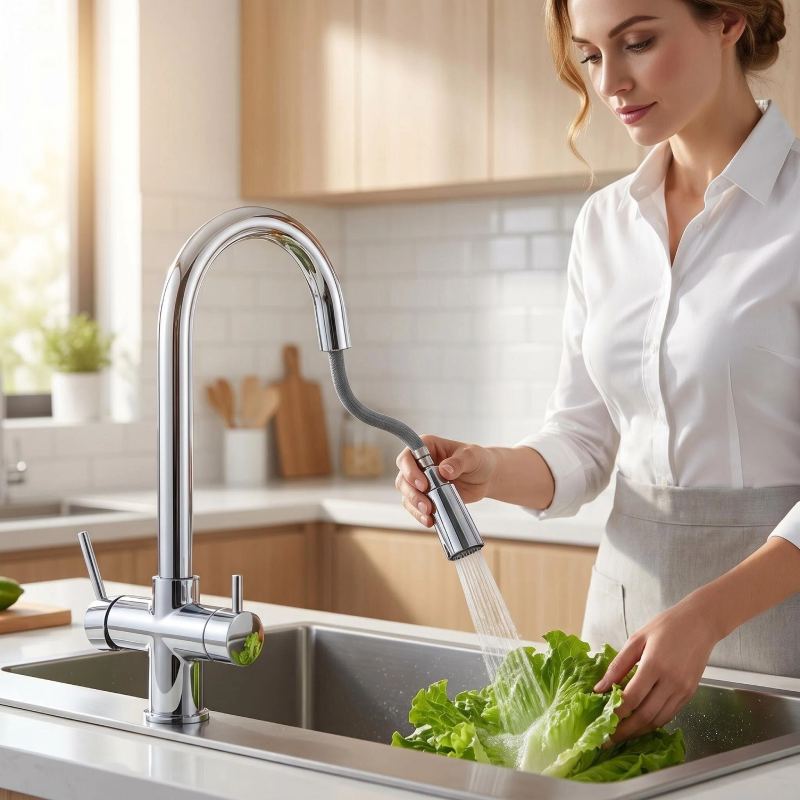
After cooking, a pull-out sprayer can reach large pots and more areas of the sink.
Instead of moving between the sink, water filter, kettle, refrigerator, and separate drink appliances, more water-related tasks can be handled from one dispensing point.
That reduces unnecessary movement and makes kitchen routines more efficient.
Well Suited to Modern Minimalist Kitchens
Finally, the design language of a multi function kitchen faucet fits naturally into many modern kitchens.
Its integrated appearance, clean lines, and reduced need for separate countertop fixtures make it particularly suitable for several kitchen styles:
Kitchen renovation — When renovating an older kitchen, a multifunction faucet can help consolidate several water functions into one planned system.
Kitchen island — Kitchen islands often have limited plumbing points, so a multifunction faucet can make better use of a single sink position.
Minimalist kitchen and modern kitchen — Fewer visible appliances and fixtures create a cleaner countertop and a more unified visual appearance.
For households that value a clean, coordinated kitchen, a multi function kitchen faucet is not only a practical tool but also part of the overall space design.
Pull-Out Functionality Is Also Being Added to Multi Function Kitchen Faucets
Adding a pull-out function to 3-way, 4-way, or 5-way systems has become a common design direction for multifunction kitchen faucets.
However, one concept needs to be clarified first:
A pull-out function is different in nature from the “way” terminology discussed earlier.
It is not itself a separate type of water.
Instead, it is a practical faucet feature that can be added to different multifunction configurations.
So a pull-out sprayer should not automatically be counted as an additional waterway.
For many households, the pull-out function may actually be more useful in daily life than adding another drinking-water option.
These four situations show where it is most useful.
Cleaning the Sink
The most difficult parts of a kitchen sink to clean are often not the bottom of the basin but the corners and seams around the edges.
Food residue and grease can collect in these areas, while the stream from a fixed faucet may not reach them effectively.
With a pull-out sprayer, the water can be directed straight into these corners.
When used with a spray mode, foam and debris can be rinsed away more easily without repeatedly wiping difficult areas by hand.
A few extra seconds of rinsing after cooking can make routine sink cleaning much easier.
Washing Cookware and Vegetables
A fixed faucet becomes inconvenient when large cookware does not fit comfortably underneath the spout.
You may end up tilting a large pot awkwardly under the faucet, creating splashes while still struggling to rinse every surface.
A pull-out sprayer solves this problem.
Large pots can stay in or beside the sink while the sprayer is pulled out and directed around the inside, outside, base, sides, and lid.
When washing vegetables or fruit, you can place them in a colander and rinse them while moving the spray around as needed.
The water flow is easier to direct, and the working range of the faucet expands from “directly under the spout” to the wider sink area.
Double-Bowl Sinks
For households with a double sink, the limitations of a fixed faucet can become even more obvious.
The spout may naturally reach one bowl better than the other, making it inconvenient to rinse or fill items in the second bowl.
A pull-out hose can easily reach across the divider and into either basin.
You can wash vegetables in one sink, drain them in the other, and move the sprayer freely between both sides.
Even the center divider becomes easier to rinse.
For many double-sink users, this is one of those features that becomes difficult to give up once they are used to it.
Filling Containers Is Easier Too
The convenience of a pull-out faucet is not limited to cleaning.
When the container you need to fill is large, heavy, or positioned away from the faucet—such as a kettle, water pitcher, vase, bucket, floor cleaner, or humidifier reservoir—a fixed faucet may require you to bring the entire container to the sink.
With a pull-out sprayer, you can bring the outlet directly to the container instead.
Fill it where it is, then return the sprayer to the faucet.
This can be easier and more stable, especially with larger containers.
For households with children, the pull-out function can also make hand washing easier by allowing the sprayer to be lowered to a more reachable position.
What Should You Consider When Choosing a Multi Function Kitchen Faucet?
After understanding the different types and advantages, we arrive at the most practical step: choosing the right one.
A multi function kitchen faucet can be a significant purchase and may remain in your kitchen for years, so choosing the wrong system can be costly.
Instead of being led by model names and feature lists, work through the following factors one by one.
First Decide Which Types of Water You Actually Need
This is the starting point of the entire buying process and arguably the most important step:
Do not start by choosing between 3-way, 4-way, or 5-way. Start by deciding which types of water you actually need.
The product type should be the result of your needs, not the other way around.
Ask yourself:
Do I need filtered water?
Do I already have a water filter at home?
Do I normally drink boiled water?
Do I want chilled water, especially in summer?
Do I regularly drink sparkling water?
Do I need boiling water for tea, coffee, or cooking?
Once you answer these questions, your functional requirements become much clearer.
You may only need a 3-way faucet for filtered water.
You may need a 4-way faucet for filtered plus sparkling water.
Or you may want a 5-way faucet offering filtered, chilled, and sparkling water.
The answer should come from your daily habits, not from whichever model has the longest feature list.
Confirm That It Has a Dedicated Filtered-Water Path
Regardless of how many functions you choose, one structural feature should always be checked:
Does the faucet have a dedicated internal waterway for filtered drinking water?
This is one of the most important structural characteristics of a multifunction drinking-water faucet.
A dedicated waterway means filtered water can travel from the filtration system to the outlet without passing through the ordinary hot/cold mixer cartridge.
How can you confirm this?
Check the product diagram and technical specifications to see whether the filtered-water line is clearly shown as a separate internal pathway.
If the product page is vague about the internal structure, it is worth asking the manufacturer before purchasing.
Confirm Compatibility with Your Water Filter or RO System
Many households shopping for a multi function kitchen faucet already have an existing water filter or RO system.
In this situation, one of the biggest risks is simple:
You buy the faucet, bring it home, and discover that it does not connect directly to your system.
Before purchasing, confirm four things.
First, tubing size. Check whether the faucet connection is compatible with the outlet tubing from your filtration system. Common sizes include 1/4 inch and 3/8 inch.
Second, connection type. Check whether the fittings match or whether adapters will be required.
Third, water pressure and flow. Some multifunction faucets require a certain minimum inlet pressure or flow rate to provide satisfactory performance. Your filtration system also affects available flow.
Fourth, filtration type. Confirm whether your system uses conventional filtration or RO. RO systems can have different flow characteristics, which may affect your expectations for drinking-water flow at the faucet.
Checking these four points before installation can prevent compatibility problems later.
Consider the Space Under the Sink
The more functions you add, the more equipment you may need under the sink.
This is one of the biggest hidden differences between a multi function kitchen faucet and a conventional faucet.
A higher-function system may need to accommodate equipment such as:
- Filter
- Chiller
- CO₂ cylinder
- Boiler
Each component takes up space, and some require nearby power outlets and room for tubing.
Before buying, physically measure your under-sink cabinet space.
Measure the width, depth, and height.
Check whether other equipment is already installed, such as a garbage disposal, water softener, or storage system.
Also confirm the number and location of available power outlets.
Many installation problems happen not because the faucet itself is unsuitable, but because the cabinet simply does not have enough space.
Ten minutes of measuring before purchase can prevent a major installation headache.
Do You Need a Pull-Out Sprayer?
Whether you need a pull-out function depends on how you actually use your kitchen, not whether the feature sounds premium.
Consider three things.
First, your cleaning habits.
Do you often rinse large pots, clean sink corners, or wash large quantities of fruits and vegetables?
If yes, a pull-out function can be very useful.
Second, sink size.
The larger and deeper the sink, the more areas may be difficult to reach with a fixed spout, which increases the value of a pull-out sprayer.
Third, whether you have a single or double sink.
As discussed earlier, double-sink users tend to benefit even more from a pull-out hose, while single-sink users can decide based on their own cleaning habits.
Also remember that a pull-out faucet includes a hose and retraction mechanism, making it mechanically more complex than a fixed spout.
Choose a model with smooth retraction and durable hose materials rather than judging the faucet only by whether it has a pull-out feature.
Installation Hole Size
Installation compatibility is one of the most easily overlooked areas, yet it is also one of the most common reasons a faucet cannot be installed as expected.
Before purchasing, confirm three things.
First, mounting hole diameter.
Because multifunction faucets may contain more internal tubing and connections, the faucet body may require a larger installation opening than some conventional models.
Common countertop mounting holes are around 1-3/8 inches or 1-1/2 inches, but the exact requirement varies by product. Measure your existing hole and compare it with the manufacturer’s specification.
Second, countertop thickness.
If the countertop is too thick, the mounting hardware may not have enough reach.
If it is too thin, the faucet may require proper reinforcement to remain secure.
Third, sink configuration.
Check whether your sink is single-hole or multi-hole and whether the faucet location could interfere with drawers, windowsills, backsplashes, or other nearby structures.
Once these three points are confirmed, you have the basic conditions needed for installation.
Many faucet returns happen simply because the mounting hole is not compatible.
Materials and Cartridge
If you want to judge faucet quality, do not rely on vague marketing terms such as “premium quality.”
Look at the actual construction.
Two things matter most: materials and cartridge.
For faucet materials, stainless steel and brass are among the most common options.
Stainless steel provides good corrosion resistance and performs well in wet environments. When reviewing specifications, check the actual grade, such as 304 stainless steel.
Brass offers good strength and excellent formability, which is why it is widely used in cast faucet bodies.
For drinking-water applications, choose brass products that comply with applicable lead-free requirements.
For the cartridge, a ceramic cartridge is the standard choice for modern quality faucets.
Ceramic discs are hard, wear-resistant, and capable of maintaining a reliable seal through a very large number of opening and closing cycles.
Some manufacturers state test ratings such as 500,000 cycles.
A higher verified cycle rating can provide an indication of durability under repeated use.
Looking at the actual body material and cartridge specification tells you much more than words like “luxury” or “high-end.”
After-Sales Support and Replacement Parts
This is especially important for a multi function kitchen faucet.
It is not simply a one-time hardware purchase. It is a system containing multiple components, some of which may wear out or require regular replacement.
Before purchasing, treat after-sales support as an important specification.
First, check whether replacement parts are easy to obtain.
Parts such as the cartridge, hose, and aerator may eventually need replacement.
Systems with filtration or sparkling-water functions may also rely on consumables or serviceable parts such as filters and CO₂ regulators.
Check whether the manufacturer sells these separately and whether they remain available after purchase.
Second, check the cost and replacement cycle of consumables.
How often does the filter need to be changed?
How much does each replacement cost?
How will the CO₂ cylinder be replaced or refilled?
These are questions worth answering before purchasing.
Do not only calculate the upfront faucet price. Consider the long-term operating cost.
Third, check the warranty.
How long is the faucet covered?
Which components are included?
What does the after-sales process look like?
A multi function kitchen faucet with reliable replacement-part availability and after-sales support is much easier to own over the long term.
Which Households Are Best Suited to a Multi Function Kitchen Faucet?
A multi function kitchen faucet is not essential for every household, but for certain types of users, its value can be particularly clear.
You do not need to compare technical specifications to decide whether it suits you.
Start by comparing it with your lifestyle.
These five types of households are among the most likely to benefit.
Households Renovating the Kitchen
If you are currently renovating your kitchen, this is one of the best opportunities to plan for a multi function kitchen faucet.
The reason is simple:
The renovation stage gives you the freedom to plan everything properly.
You can decide how much under-sink space to reserve, how many power outlets are required, how the plumbing should be routed, and what mounting-hole size is needed.
It is much easier and less expensive to make these decisions during construction than after the kitchen is finished.
If you decide to upgrade later, you may need to modify plumbing, add outlets, or alter the countertop.
So for households currently renovating, even if you do not need every multifunction feature immediately, it is worth considering whether you should reserve enough cabinet space, power access, and installation room for future upgrades.
Planning ahead is much easier than rebuilding later.
Households Already Using an Under-Sink Water Filter
Households that already have an under-sink water filter are among the most natural candidates for upgrading to a multi function kitchen faucet.
The filtration equipment is already installed.
What is missing is simply a way to integrate the filtered water into the main kitchen faucet.
For these households, a 3-way kitchen faucet is often a practical choice.
It integrates filtered water into the main faucet and replaces the separate small drinking-water faucet.
You keep the existing filtration system, while the countertop becomes cleaner and the number of separate fixtures is reduced.
In other words, this is a typical case where the treatment equipment already exists and only the dispensing point needs to be integrated.
Households That Frequently Drink Sparkling Water
If sparkling water is part of your daily routine—if you drink it every day, regularly keep bottles in the refrigerator, or already make sparkling water at home—then a multifunction faucet with a sparkling-water function may be particularly relevant.
These households can consider systems that combine chilled + sparkling water, such as certain 5-way configurations.
This combination effectively moves part of the sparkling-water experience from bottled storage or a countertop appliance to the kitchen sink.
You can dispense chilled sparkling water whenever you want without storing as many bottles or moving cases of sparkling water around.
For frequent sparkling-water users, this is one of the functions that can be used every day.
Households That Frequently Drink Tea and Coffee
Tea and coffee create another clear use case.
Both require hot water, and the traditional method usually involves waiting for a kettle or using a separate hot-water appliance.
Households that frequently prepare tea or coffee may consider a system with a boiling water function.
Boiling water can be available directly from the kitchen dispensing system, reducing the need to wait for a kettle each time.
For households with busy mornings or frequent hot-drink preparation, the convenience can be noticeable.
Households That Prefer a Clean, Minimalist Countertop
The final group is less focused on adding functions and more focused on reducing visible clutter.
A clean countertop is a major goal in many modern kitchen designs.
The fewer items sitting on the counter, the cleaner the kitchen looks and the easier it is to maintain.
For these households, the value of a multi function kitchen faucet can be summarized in one sentence:
One faucet instead of multiple fixtures.
A main faucet, drinking-water faucet, sparkling water tap, kettle, or other countertop water appliances may be reduced or consolidated depending on the system.
The result is a cleaner visual appearance.
If your kitchen follows a minimalist, modern, or island-based design, a multifunction faucet can be both a practical upgrade and part of the overall space planning.
What Are the Disadvantages of a Multi Function Kitchen Faucet?
Every product has another side, and a multi function kitchen faucet is no exception.
This section is not meant to discourage you from buying one. It is here to make sure you understand the trade-offs before deciding whether the benefits are worth them.
The first disadvantage, and the most obvious one, is higher upfront cost.
A multi function kitchen faucet generally has a more complex internal structure, more water functions, and more specialized components than a standard kitchen faucet.
Higher-function systems such as 5-way configurations can move well into the premium kitchen-appliance price range.
That extra cost pays for broader functionality, but if you rarely use most of those functions, then part of the purchase price may simply be paying for features you do not need.
The second disadvantage is space.
A multifunction system may require additional equipment under the sink.
A filter, chiller, CO₂ cylinder, and boiler all need space, and power outlets and tubing also need to be planned.
For households whose sink cabinet is already occupied by a garbage disposal, water softener, or storage system, the biggest problem may be that the system simply does not fit.
The third disadvantage is installation complexity.
Chilled, sparkling, and boiling-water systems in particular are more complex to install than a standard kitchen faucet.
They may require electrical connections, gas tubing for CO₂, additional plumbing, and under-sink equipment.
Professional installation may be appropriate depending on the system.
This means higher installation cost and more planning than simply replacing a conventional faucet.
The fourth disadvantage is ongoing cost.
Filters and CO₂ are consumables that need to be replaced periodically.
Filters have a service life, and CO₂ cylinders eventually run out.
Before buying, it is worth calculating the full cost:
How much does the faucet cost?
How often do the consumables need replacing?
What is the annual operating cost?
Looking at the three-year cost can give you a more realistic idea of whether the system fits your budget.
Is a Multi Function Kitchen Faucet Worth It?
There is no single answer to this question, but there is a clear way to evaluate it.
If you only need ordinary hot and cold water and mainly use the kitchen faucet for washing vegetables, dishes, and general cleaning, then a standard kitchen faucet may already be enough.
A multifunction model could simply give you features you do not use.
If you already have a water filter and are tired of having a separate small drinking-water faucet on the countertop, then a 3-way kitchen faucet can be a very practical upgrade.
Your existing filtration system can remain in place while the faucet integrates filtered water into the main dispensing point.
If you drink large amounts of chilled or sparkling water every day, and sparkling water is part of your lifestyle, then a higher-function multifunction system may have real value.
It can reduce the need for bottled-water storage, carrying, and separate preparation.
If you frequently drink tea or coffee, or need convenient hot water for cooking, then a system with a boiling-water function may also be worth considering.
The convenience of immediate hot water can be noticeable in time-sensitive routines.
So the decision should never be based on the idea that “more functions are automatically better.”
It should be based on whether your daily habits justify those functions.
The best Multi function kitchen faucet is not the one with the most functions. It is the one whose function combination best matches the way your household actually uses water.
Once you understand that, the decision becomes much easier.
How to Choose the Right Multi Function Kitchen Faucet
If you compress everything discussed above into one decision path, the process becomes quite simple.
Start with your most important water needs and work toward the product type that matches them.
- Only need filtered water? → Choose a 3-Way Kitchen Faucet with hot, cold, and filtered water. This is the simplest integrated option and is especially suitable for households that already have an under-sink filtration system.
- Need filtered water plus a second drinking-water function? → Choose a 4-Way Kitchen Faucet and check exactly which additional water function the manufacturer provides, such as chilled or sparkling water.
- Need Filtered + Chilled + Sparkling? → Choose a 5-Way Multifunction Faucet to combine everyday drinking water with chilled and sparkling water.
- Need instant boiling water? → Choose a Boiling Water Multifunction Faucet for tea, coffee, cooking, and other situations where rapid access to very hot water is useful.
- Also want easier cleaning? → Choose a model with a Pull-Out Sprayer in addition to the water functions above, so the faucet not only provides multiple types of water but can also reach a larger working area.
Once you follow this path, each branch leads to a clearly defined product category.
That is the real logic behind a multifunction faucet range.
The goal is not to stack as many functions as possible into one faucet.
It is to match each combination to a specific household need.
Compare your own answers with the options above, and the type of faucet that suits you should become much clearer.
Conclusion
The modern Multi function kitchen faucet has evolved far beyond the role of a simple hot/cold mixer.
It has become a complete kitchen water dispensing hub, bringing filtration, chilling, sparkling water, boiling water, and cleaning functions together at one dispensing point.
That is exactly why the wrong question to ask is:
“Is a 3-way or 5-way faucet more advanced?”
The number of functions is not the real measure of whether a faucet is right for you.
The better question is:
Which water functions do I actually use every day?
From there, make your final decision based on six factors:
Water functions — Which types of water do you actually need?
Under-sink space — Is there enough room for the required equipment?
Filtration system — Is the faucet compatible with your existing filtration or RO system?
Installation requirements — Does your sink, countertop, plumbing, and power setup meet the requirements?
Pull-out needs — Would a pull-out sprayer make everyday cleaning easier?
Maintenance — Are the long-term consumable costs, replacement parts, and after-sales requirements acceptable?
If all six factors work for your kitchen, then you have likely found the right Multi function kitchen faucet for your needs.
.jpeg?w=800&h=800)