
In modern home kitchen design, practicality and convenience have become the core criteria when choosing a faucet. The pull-out sprayer has emerged as a mainstream upgrade in kitchen faucets, completely breaking the limitations of traditional fixed faucets. But what exactly is it? How does it enhance daily kitchen life? And what are its advantages compared to traditional faucets? Here’s a clear explanation of what a pull-out kitchen faucet is, its core functions, and how it differs from conventional faucets.
Features of Pull-Out Kitchen Faucets
1. High Flexibility and Extendable Reach for Complete Cleaning
Pull-out faucets come with a highly elastic retractable hose that can be freely extended and retracted, eliminating the limitations of fixed water outlets. The faucet can rotate at multiple angles, covering every corner of the sink. Whether washing large pots and pans, rinsing corners and crevices, or cleaning countertops, it allows effortless access, fully addressing the limitations of traditional faucets.
2. Dual Spray Modes for Greater Versatility
Equipped with both standard stream and powerful spray modes, the faucet allows one-button switching. The gentle stream is perfect for everyday tasks like washing vegetables, rice, or dishes, providing a smooth, splash-free flow. The powerful spray concentrates water pressure and covers a wide area, quickly removing stubborn residues, grease, or grime, making it suitable for various kitchen tasks.
3. Water-Saving, Noise-Reducing, and Space-Efficient
With a built-in precision aerator, the water flow is soft and smooth while reducing splashes and noise, effectively saving water without compromising performance. Its sleek, integrated design keeps countertops clean and uncluttered, making it ideal for compact kitchens.
4. Universal Compatibility with Different Sinks and Kitchen Styles
Highly versatile, pull-out faucets fit single, double, and large sinks, providing easy installation. They come in a variety of finishes—classic silver, matte black, gunmetal gray, brushed gold—blending seamlessly with modern, minimalistic, rustic, or traditional kitchens while balancing functionality and aesthetics.
Best Pull-Out Kitchen Faucets
Ferguson Pull-Out Faucets
A well-known brand in the kitchen and bathroom industry, Ferguson pull-out faucets highlight “integrated functionality and user-friendly design.” With features like magnetic docking, multi-mode water flow, built-in soap dispensers, and even touch or voice control in some models, Ferguson faucets enhance hygiene by minimizing contact, especially when handling raw foods. Ferguson products are compatible with both countertop and wall-mounted installations, single or double sinks, and support additional spray attachments. With technologies like Power Clean™, spray power is increased by 50%, improving cleaning efficiency while reducing splashing. Quick-connect installation makes setup easier, and comprehensive after-sales support ensures a reliable experience.
Moen Pull-Out Kitchen Faucets
Moen, a leading mid-to-high-end kitchen faucet brand, is renowned for superior user experience and durability. Their pull-out faucets feature advanced retractable systems capable of over 400,000 uses, 360-degree rotation for full coverage, and magnetic or weighted retraction for smooth automatic return. Water flow switches between gentle aerated streams for vegetables and powerful sprays for tough cleaning. Built with lead-free brass bodies, stainless steel hoses, and durable ceramic cartridges, Moen faucets resist corrosion and wear. Certified water-saving, they reduce water consumption by 30-45% while providing long-term reliability and some models even come with a lifetime limited warranty.
Kohler Pull-Out Kitchen Faucets
Kohler emphasizes “design aesthetics and premium materials,” combining functionality with home décor. Their pull-out faucets come in multiple styles—classic minimalist, vintage, and modern luxury—with finishes like matte black, brushed gold, and polished chrome. The copper body and ceramic cartridge ensure durability and leak prevention. Some models feature three-function spray heads with magnetic docking, balancing beauty and practicality, making them suitable for various kitchen styles.
Liliumfaucet 3-Way Pull-Out Kitchen Faucet
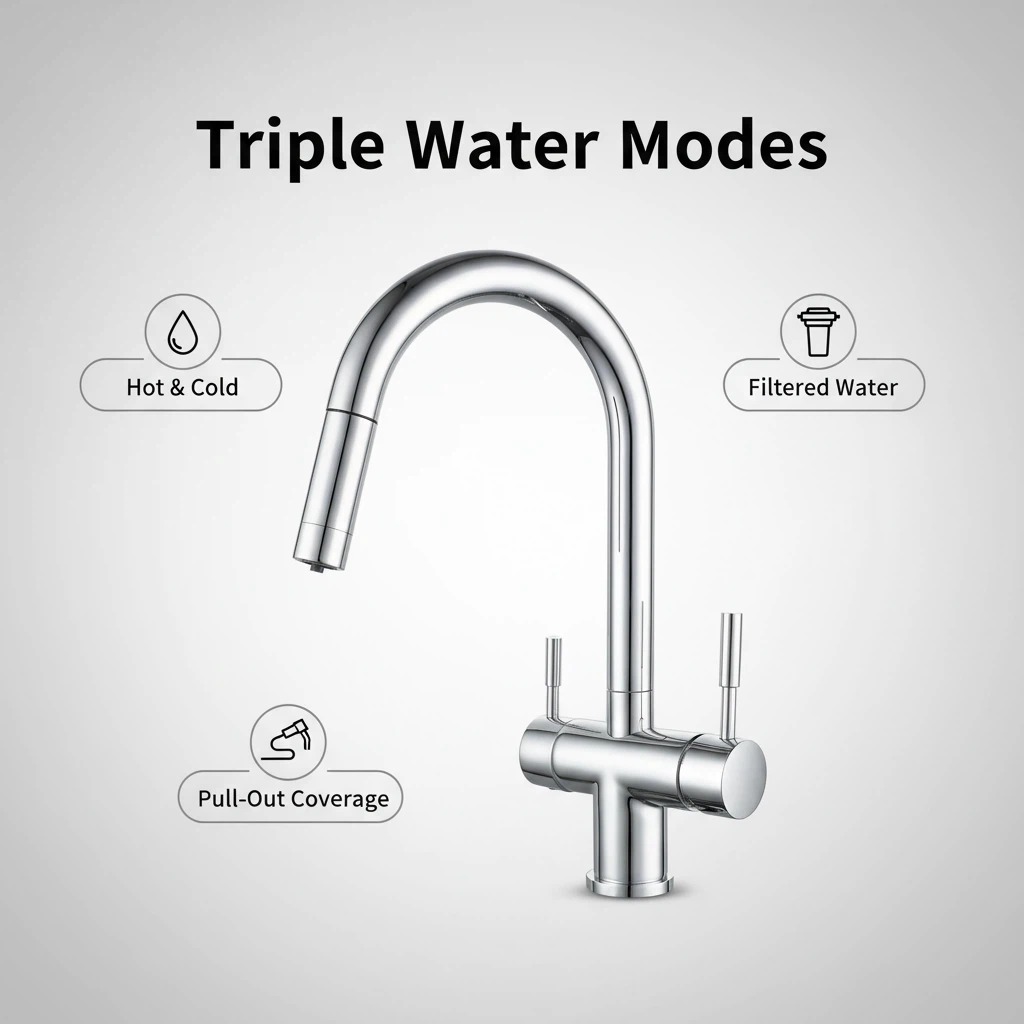
Liliumfaucet’s 3-way pull-out faucet focuses on “multi-functional integration” to meet high-end kitchen water needs. It provides hot, cold, and filtered water through separate internal channels, preventing cross-contamination and enabling direct connection to under-sink RO systems without extra drilling. Dual handles allow easy switching between water types, and the pull-out spray rotates 360 degrees for complete cleaning coverage. Made of lead-free brass with high-quality ceramic cartridges, the faucet is durable, corrosion-resistant, and easy to install. A two-year warranty ensures reliability, providing a convenient, healthy, and premium kitchen solution.
Kitchen Styles Suitable for Pull-Out Sprayer Faucets
Modern Kitchen Faucets
Modern kitchens favor minimalism, clean lines, and simple forms. Pull-out faucets fit perfectly with these spaces, featuring integrated sleek designs without unnecessary decorations. Materials like polished metal, matte black, or black brushed finishes provide a high-end appearance, seamlessly pairing with minimalist cabinetry and stone countertops, combining style and functionality.
Vintage Kitchen Options
Vintage kitchens value warmth and classic lines. Pull-out faucets in matte black or brushed copper complement retro, French, American, or rustic kitchens. Rounded curves and vintage handles enhance aesthetic appeal, combining traditional style with modern convenience.
Traditional or Wooden Kitchens
Pull-out faucets also suit traditional or wood-themed kitchens. Choosing rounded, understated designs allows integration with wood cabinetry and countertops, providing practical functionality without disrupting the overall aesthetic.
Pull-Out Spray Faucet Replacement Guide
When to Replace
Pull-out faucets are widely used in kitchens and bathrooms due to their flexibility. Replacement is recommended in cases such as:
- Spray head damage: inconsistent flow, leaks, or non-functional spray modes.
- Severely worn components: cracked or hardened hoses, worn plating, or rust.
- Poor user experience: low water pressure, inadequate spray coverage, or limited pull-out length.
- Style mismatch or functional upgrade: after renovation or for improved features like pressurization, anti-splash, or thermostatic control.
- Connection issues: damaged or incompatible hose or faucet interfaces.
How to Choose a Compatible Model
- Check connector size: Most faucets use standard G1/2 connections; verify existing hose and faucet measurements. Adapters may be used but ensure they are leak-proof.
- Check water pressure: Normal household pressure is 0.1-0.3 MPa. Low pressure requires a pressure-boosted faucet; high pressure benefits from pressure-stabilized designs.
- Confirm spray type and usability:
- Stream, shower, pressure-boosted, or multi-mode sprays.
- Kitchen-specific models: long hose length (1.5–2 m), anti-tangle design, easy-clean nozzles.
- Choose reliable brands for quality assurance and better after-sales support.
Common Issues with Pull-Out Spray Faucets
During long-term use, pull-out spray faucets may encounter various minor problems due to factors such as water quality, usage frequency, and installation precision. Below are the three most common issues along with simple, actionable solutions. If the problem cannot be resolved, professional after-sales support should be contacted.
1. Dripping or Leaking
This is the most frequent issue, usually occurring at the connection between the spray head and hose or between the hose and faucet body. In some cases, leaks may occur from the spray nozzles, affecting usability and wasting water.
Simple Solutions:
- Leaking at Connections: First, turn off the water supply. Use a wrench to gently tighten the threaded connections. If leakage persists, inspect the sealing washer (rubber O-ring). If the washer is worn, deformed, or damaged, replace it with a washer of the same size.
- Spray Nozzle Leaks: These are often caused by clogged nozzles, leading to misdirected water flow. Use an old toothbrush dipped in vinegar to clean the nozzles, or gently clear blockages with a needle. After removing mineral deposits and debris, the leakage usually improves.
2. Spray Head Retraction Problems
Symptoms include the spray head failing to retract automatically or retracting with resistance or jerky movement, affecting convenience. This is often related to the hose or spring mechanism.
Simple Solutions:
- Check the Hose: Ensure the hose is not twisted, tangled, or obstructed. Straighten the hose and remove any obstacles to allow smooth extension and retraction.
- Clean and Lubricate: If the hose surface is greasy or covered with scale, wipe it clean with a damp cloth. Apply a small amount of petroleum jelly or specialized lubricant to the connection between the hose and faucet body to reduce friction.
- Check the Spring: If the spring is worn or lacks tension, adjust its position if possible. If the problem persists, replace the spring assembly with a compatible component.
3. Low Water Pressure
Symptoms include weak flow or dispersed spray, which can make cleaning difficult, especially when washing greasy kitchen items. Common causes include low water pressure, clogged spray nozzles, or restricted hoses.
Simple Solutions:
- Clear the Nozzle: Soak the spray head in vinegar for 10–15 minutes to soften mineral deposits. Use a toothbrush or needle to clear blocked holes.
- Inspect the Hose: Check for bends, kinks, or internal blockages. Straighten bends or flush the hose with water if necessary.
- Check Household Water Pressure: If all faucets show low pressure, ensure the main water valve is fully open or consult your building management. If only the spray head is affected, consider replacing it with a pressure-boosted model.
When to Contact Professional After-Sales Support
Contact professional service when:
- Severe leaks persist despite tightening connections or replacing washers, especially if the threads are damaged.
- The retraction mechanism is broken (e.g., spring broken, hose damaged) and cannot be repaired at home.
- Water pressure remains abnormal after checking water supply, hose, and spray nozzle, indicating internal faucet issues.
- Spray head or hose is severely aged or cracked, with no compatible replacement parts available.
- Installation issues arise beyond personal capability.
Pull-Out Kitchen Faucet Installation
Installing a pull-out kitchen faucet should follow the principle of “Prepare → Install → Test.” The installation difficulty is moderate and can be done independently. Ensure all parts and tools are ready, and follow safety protocols to avoid leaks or component damage.
Installation Overview
The key to installation is ensuring sealed connections and secure mounting to prevent leaks. Steps:
- Turn Off the Water Supply: Close the main kitchen valve clockwise. If the faucet has a dedicated angle valve, close it instead.
- Remove the Old Spray Head (if replacing): Use a wrench to gently unscrew the connection between the old spray head and hose. Remove old components and clean the connection area of debris and scale.
- Install the New Hose: Connect one end to the faucet body and hand-tighten, then secure lightly with a wrench (avoid over-tightening). Pass the other end through the faucet hole, leaving enough hose length to prevent kinks.
- Connect the New Spray Head: Attach the spray head to the hose, hand-tighten, then lightly secure with a wrench to ensure a sealed connection.
- Secure the Faucet Body (if replacing entire faucet): Insert the faucet into the countertop hole, then install washers and nuts underneath. Tighten to ensure the faucet is stable and does not wobble.
- Test Water Flow: Turn on the water, extend the spray head, switch between spray modes, and check for leaks. Ensure smooth retraction. Retighten connections or replace washers if needed.
Tools and Parts Checklist
Tools:
- Adjustable wrench (for tightening connections)
- Screwdrivers (Phillips and flathead)
- PTFE tape (for threading)
- Cleaning cloths (2–3 pieces)
- Vinegar (optional, for cleaning old scale)
- Gloves (for grip and protection)
Parts:
- New pull-out spray head
- Compatible pull-out hose (ensure size matches existing connections)
- Sealing washers (2–3, as backups)
- Mounting nuts and washers (if replacing the whole faucet)
- Adapter fittings (if connection sizes differ)
Safety Precautions
- Always turn off the water before installation.
- Apply moderate force when using a wrench to avoid damaging threads or components; place a cloth between the wrench and faucet to protect finishes.
- Prevent hoses from bending, twisting, or being pinched during installation.
- Maintain stability under the countertop, especially on smooth surfaces—consider using a non-slip mat.
- Test the faucet after installation and check for leaks before regular use.
Tips for Longevity and Leak Prevention
- Regular Cleaning: Wipe spray head and nozzles weekly; soak in vinegar monthly to remove scale.
- Proper Usage: Avoid forcefully pulling or twisting the hose; allow the spray head to retract naturally. Switch spray modes gently.
- Periodic Inspection: Check connections and washers every 3–6 months; replace worn washers and tighten loose connections.
- Avoid Impacts: Prevent hard impacts to the faucet body or spray head to avoid damaging finish or components.
- Water Quality Maintenance: For hard water, consider a water filter to reduce scale buildup. Shut off the angle valve during extended periods of non-use.
Conclusion
Pull-out spray kitchen faucets combine practicality, convenience, and style, making them an essential upgrade for modern kitchens. Their flexible hose, dual spray modes, and water-saving design not only simplify daily tasks like washing dishes, rinsing vegetables, and cleaning the sink but also enhance the overall kitchen experience.
By understanding common issues, knowing when to replace components, and following proper installation and maintenance practices, you can ensure long-lasting performance and avoid leaks or malfunctions. Whether you choose a high-end brand like Ferguson, Moen, Kohler, or a multifunctional solution like the Liliumfaucet 3-way pull-out faucet, these faucets offer a perfect balance of functionality, durability, and aesthetics for any kitchen style—modern, vintage, or traditional.
Investing in a quality pull-out spray faucet is not just a functional choice, but a step toward a cleaner, more efficient, and visually appealing kitchen.
.jpeg?w=800&h=800)
.jpg?w=375&h=247)